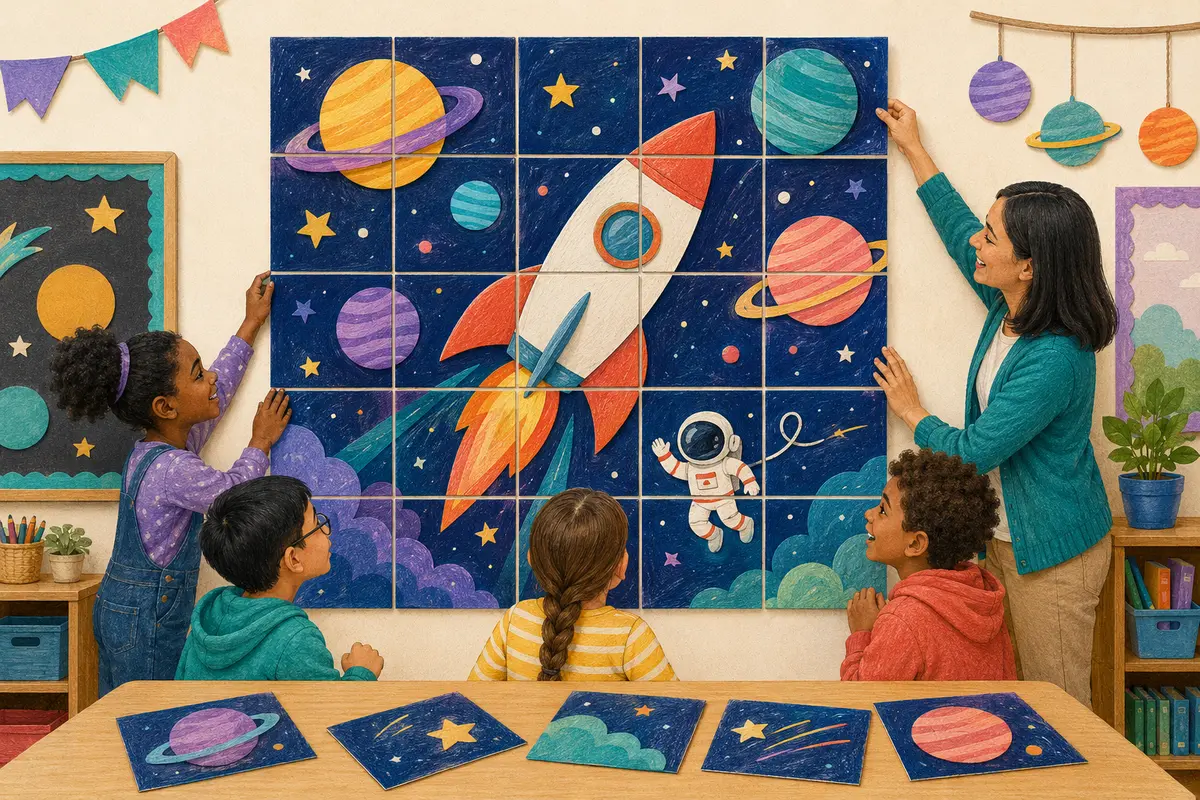
A Space Day collaborative poster gives every student a small mission and the whole class one spectacular reveal. The activity combines art, science vocabulary, sequencing, and teamwork without requiring special equipment or a complicated setup.
Why a Space Day poster works
Space is naturally rich in color, pattern, scale, and curiosity. A numbered 25-piece poster lets students work independently on rockets, planets, stars, astronauts, or an alien scene, then discover how every page connects. The final mural creates an instant focal point for a science wall, library display, or school Space Day celebration.
- Preparation time: about 10 minutes after downloading the PDF.
- Student work time: 30–45 minutes, plus 10–15 minutes for assembly.
- Use crayons or colored pencils when the design contains small planets and stars.
Choose the right outer-space theme
A playful planets-and-aliens design works well for younger students, while a rocket or universe scene suits a broader range of elementary grades. Choose a poster with large shapes for a short activity and more detailed galaxies, constellations, or space patterns when students have a full art period.
For a stronger learning connection, preview five words students should notice in the artwork—planet, orbit, crater, galaxy, and astronaut—and invite them to use the vocabulary during the final reveal.
A simple 45-minute lesson plan
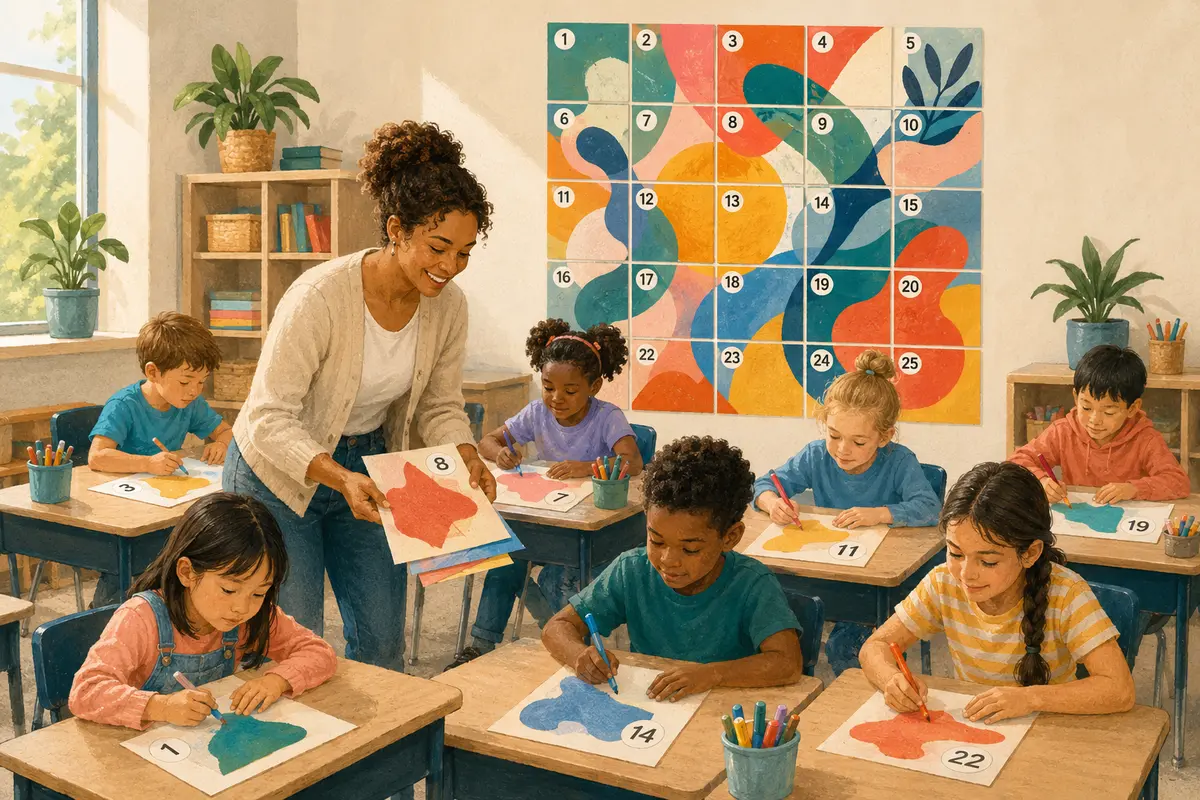
Begin with a five-minute question: What do scientists need to explore space together? Distribute one numbered page to each student and allow about 25 minutes for coloring. Use the final 15 minutes to place pages in numerical order, assemble the 5 × 5 grid, and ask students to identify details that were impossible to recognize on a single sheet.
If the class needs more time, use the pages as morning work or an early-finisher station across several days. Store completed sheets in a numbered folder so the grid is ready to assemble.
Print and assemble the 5 × 5 poster
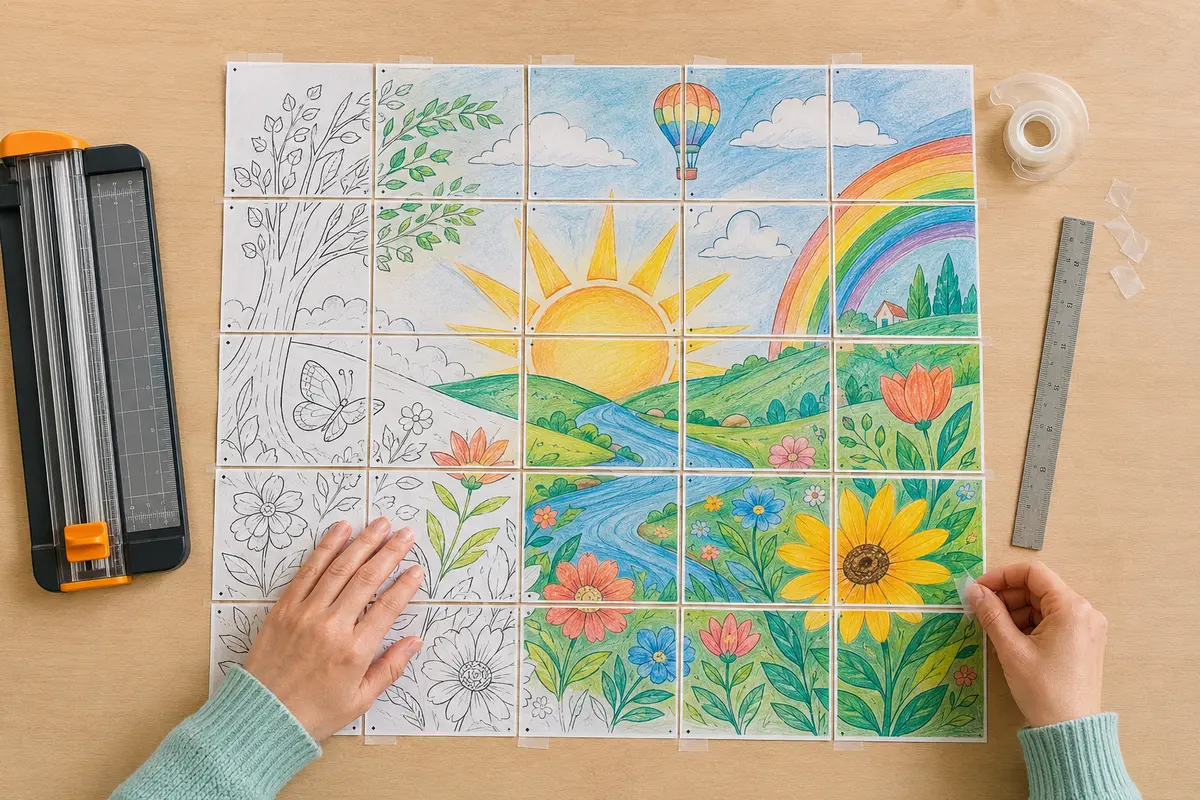
Download the PDF to a computer, open it in a PDF reader, and print the student pages single-sided at Actual Size or 100%. Keep the same paper size and orientation for every sheet. Arrange the finished pages from left to right in five rows of five before taping or gluing anything.
On US Letter paper, an untrimmed 5 × 5 arrangement can reach about 42.5 × 55 inches (108 × 140 cm). The exact finished size depends on the file margins and whether pages overlap. Measure the display area before assembly if the poster will go on a door or narrow bulletin board.
- Print one test page before the full set.
- Write student names lightly on the back.
- Tape rows from behind, then connect the rows together.
For classes with fewer than 25 students
Give early finishers a second page, invite pairs to share the most detailed pieces, or complete several pages together during a teacher-led small group. For a class of 20, assign five extra pages to volunteers after everyone has finished a first piece. Keep the extra assignments visible so no page is missed.
For more than 25 students, pair selected students, create two smaller teams working on two different Space Day posters, or assign support roles such as page sorter, assembly checker, vocabulary reporter, and display designer.
Connect the art to science and writing
Ask younger students to sort visible objects into things found in space and things humans send into space. Older students can label a planet, write a short astronaut log, compare inner and outer planets, or explain how individual poster pieces model the way scientific teams combine evidence.
A useful exit ticket is: My page looked like ___ by itself, but in the complete poster it became ___. This turns the surprise reveal into a clear observation about parts, systems, and collaboration.
Common mistake and quick solution
The most common assembly problem is a row that appears not to align. Before reprinting, check the page numbers, orientation, and row order. A page rotated 180 degrees can look almost correct when it contains abstract stars or curved orbit lines. Compare each sheet with the miniature assembly guide, then confirm that every page was printed with the same scale setting.
Frequently asked questions
What grade levels can use a Space Day collaborative poster? Large, bold designs work especially well in kindergarten and early elementary, while detailed space scenes can engage upper elementary and middle-grade groups. Do students need to use matching colors? No. A shared limited palette can create a coordinated look, but varied student choices make the final mural lively. Can the poster support a science lesson? Yes—pair it with space vocabulary, planet research, observation writing, or a discussion about scientific teamwork. Where can I find the Space Day designs? Explore the complete Space Day collection linked below.
Ready to create together?
Choose a printable, give every student a piece, and watch the big picture come to life.
Explore Space Day collaborative posters ↗