In this guide
Use a shared chess scene to help students connect Veterans Day learning with thoughtful partner talk. This lesson centers on listening and turn-taking: skills the class can practice while creating a mural together.
This guide focuses on one specific printable: Friendship Forged Through Service. It includes real shop previews, a suggested teaching sequence and the checked file specifications. The lesson ideas are optional teacher-created extensions, not additional worksheets included with the product.
View the Friendship Forged Through Service poster in the shop.
Look closely at this design
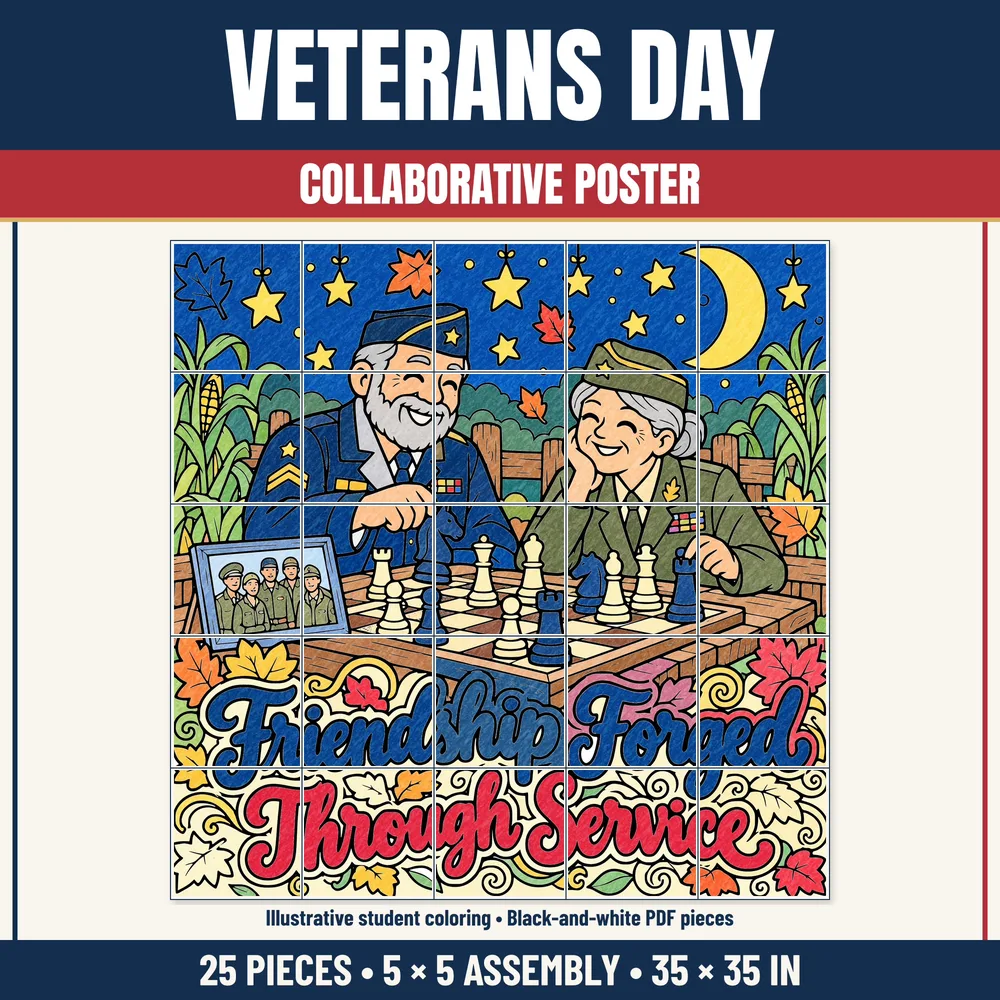
Two veterans share a chess game in a garden scene, surrounded by stars, leaves and a nighttime sky. The message makes friendship the starting point for a Veterans Day conversation. Small details on the board and in the background give students something specific to notice as their separate pages become one picture.
Lesson focus: Listening, turn-taking and friendship.
Guiding question: What does a helpful partner do when it is someone else’s turn?
Teach the lesson in three stages
Introduce and model
Before coloring, model two short partner conversations about a classroom task. In one, both speakers interrupt; in the other, one speaks while the other listens and responds. Ask students to describe an observable difference without labeling either person as a bad friend.
Let students practice
During the art, pair students for a brief check-in. One describes a line or shape on their tile, and the listener repeats one detail accurately. Switch roles so each student gets a turn. Coloring remains individual or shared according to your class plan.
Assemble and reflect
After assembly, revisit the chess illustration and your opening question. Students write or dictate one partner action they practiced, such as waiting, asking a question or checking directions together. Put a small number of approved responses on separate caption cards.
What to prepare and print
The checked listing and gallery describe a digital PDF with 25 black-and-white picture tiles and one assembly map with directions, making 26 PDF pages in total. The artwork forms a five-by-five grid with a 35 × 35-inch finished picture at the specified scale. Each picture tile is 7 × 7 inches. No physical poster is shipped.
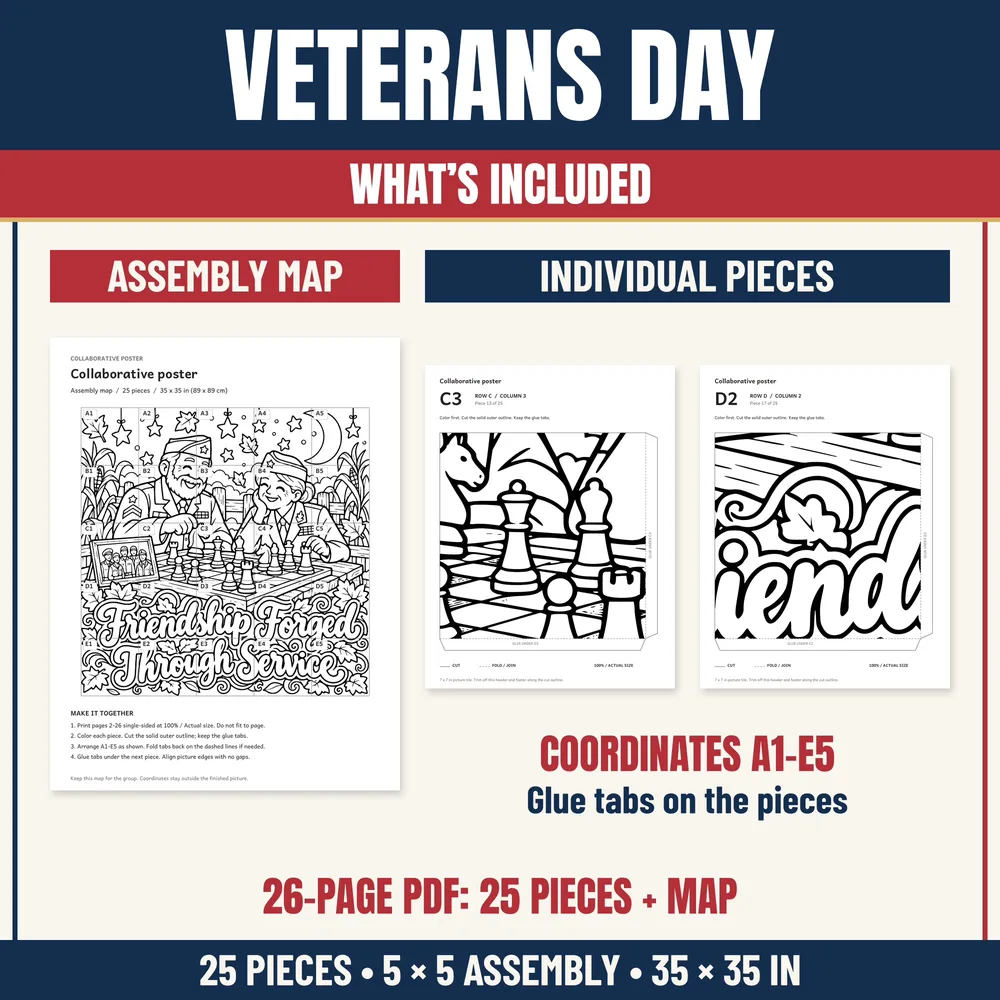
Print a test tile first, single-sided at 100% or Actual Size using the paper specified in your downloaded file. Keep the same settings for all pages. Color before cutting, preserve the joining tabs and check the A1–E5 coordinates against the map before gluing. Leave extra space around the 35-inch square for backing and readable captions.
For fewer than 25 students, share extra pieces among volunteers or groups. For more than 25, use partners and meaningful checking or assembly jobs. Read the full printing and assembly guide if this is your first tiled mural.
Adapt participation for your learners
Offer a picture cue for listen, speak and wait. Students can point, gesture or draw their chosen action. Older learners can explain how the same routine helps in a science investigation or group reading task.
Keep military-family stories optional. Students can respond to the class source, the artwork or the group process. Preview the discussion and provide an equally valued quiet art or sorting role where appropriate.
Check the learning, then display it
Look for a specific action in each reflection. I was nice is difficult to assess; I waited until my partner finished explaining identifies something the learner actually practiced.
Use a small number of readable, student-approved captions around the mural. Explain what the class practiced and identify any source used for factual statements. Keep private names, contact details and personal histories off a public hallway board.
Keep the Veterans Day context accurate
Veterans Day is observed on November 11 in the United States and honors those who served in the military. Memorial Day has a different commemorative purpose. Use the Department of Veterans Affairs background to prepare your introduction and select further reading appropriate to your class.
The people pictured in this poster are illustrated characters. Do not identify them as real individuals or infer their experiences without a separate reliable source. The project can support gratitude and learning without requiring a visitor, personal disclosure or a ceremony.
Is this the right Veterans Day poster for your class?
Choose this design when your main purpose is listening, turn-taking and friendship. Compare the colored example and printable details before buying. The preview colors are suggestions; your students can use their own palette.
To compare every message and all nine current products, return to the complete Veterans Day collection guide. It links to each design and its individual teaching guide.
View Friendship Forged Through Service and the current download details →
Product and gallery checked October 29, 2026. Teaching suggestions are original extensions; the shop listing supplies the purchased PDF.
Ready to create together?
Choose a printable, give every student a piece, and watch the big picture come to life.
View Friendship Forged Through Service poster ↗Frequently asked questions
What is included in this Veterans Day poster PDF?
The checked listing describes 26 PDF pages comprising 25 black-and-white picture tiles and one assembly map with directions. The colored gallery example illustrates a possible finished result. No physical poster is shipped.
How can I use the chess illustration to teach listening?
Model a short partner conversation, then ask one learner to describe a detail on a tile while the other repeats it accurately. Switch roles and finish with a caption naming a helpful listening action.
How large is the assembled picture?
At the specified scale, 25 picture tiles measuring 7 × 7 inches form a five-by-five picture measuring 35 × 35 inches. Follow the downloaded directions and leave additional space for backing and captions.
How should I introduce the Veterans Day context?
Use a short verified class source for Veterans Day facts. The chess scene is an illustration, so students should not invent a military history or personal experience for the pictured characters.