In this guide: all 11 posters
A Native American Heritage Month collaborative poster can turn individual coloring pages into one shared classroom display. Choosing the right design starts with the lesson you want students to explore: cornhusk art, seeds, weaving, wild rice, pottery, patchwork, longhouses, canoes or another specific subject.
This guide looks at all 11 products currently listed in the Native American Heritage Month collection. Each design has its own section, product images and direct shop link, so you can compare the options before choosing a printable.
Use the poster alongside learning from Native authors, artists, educators or tribal resources. Name the particular nation or community in the lesson and distinguish what students observe in an illustration from what they learn in a source. The projects below are printable classroom illustrations; the descriptions here do not claim tribal endorsement.
Browse the complete Native American Heritage Month collection.
Looking for the printables? Browse the Native American Heritage Month collection ↗ or use the classroom plan below.
Choose a poster by your classroom focus
| Poster | Classroom focus | Grade range in the listing | Product |
|---|---|---|---|
| Haudenosaunee Cornhusk Art Collaborative Poster | Cornhusk art and making | Grades 2–6 | View product |
| Cherokee Seeds, Future Roots Collaborative Poster | Seeds, growth and future roots | Elementary and middle school | View product |
| Diné (Navajo) Wool Becomes Woven Art Collaborative Poster | Wool and weaving | Grades 2–6 | View product |
| Haudenosaunee Three Sisters Grow Together Collaborative Poster | Three Sisters and growing together | Elementary and middle school | View product |
| Snoqualmie Salmon, Shared Futures Collaborative Poster | Salmon and shared futures | Grades 1–6 | View product |
| Ojibwe Wild Rice Living Heritage Collaborative Poster | Wild rice and living heritage | Grades 1–5 | View product |
| Pueblo Clay, Generations of Skill Collaborative Poster | Clay, pottery and artistic skill | Grades 2–6 | View product |
| Seminole Patchwork Living Heritage Collaborative Poster | Patchwork, color and pattern | Grades 2–6 | View product |
| Seneca Longhouses Hold History Collaborative Poster | Longhouses and history | Elementary and middle school | View product |
| Snoqualmie Canoe Collaborative Poster | Canoes and community | Grades 1–6 | View product |
| Potawatomi Ribbons Tell Stories Collaborative Poster | Ribbon skirts and making | Grades 2–8 | View product |
1. Haudenosaunee Cornhusk Art Collaborative Poster
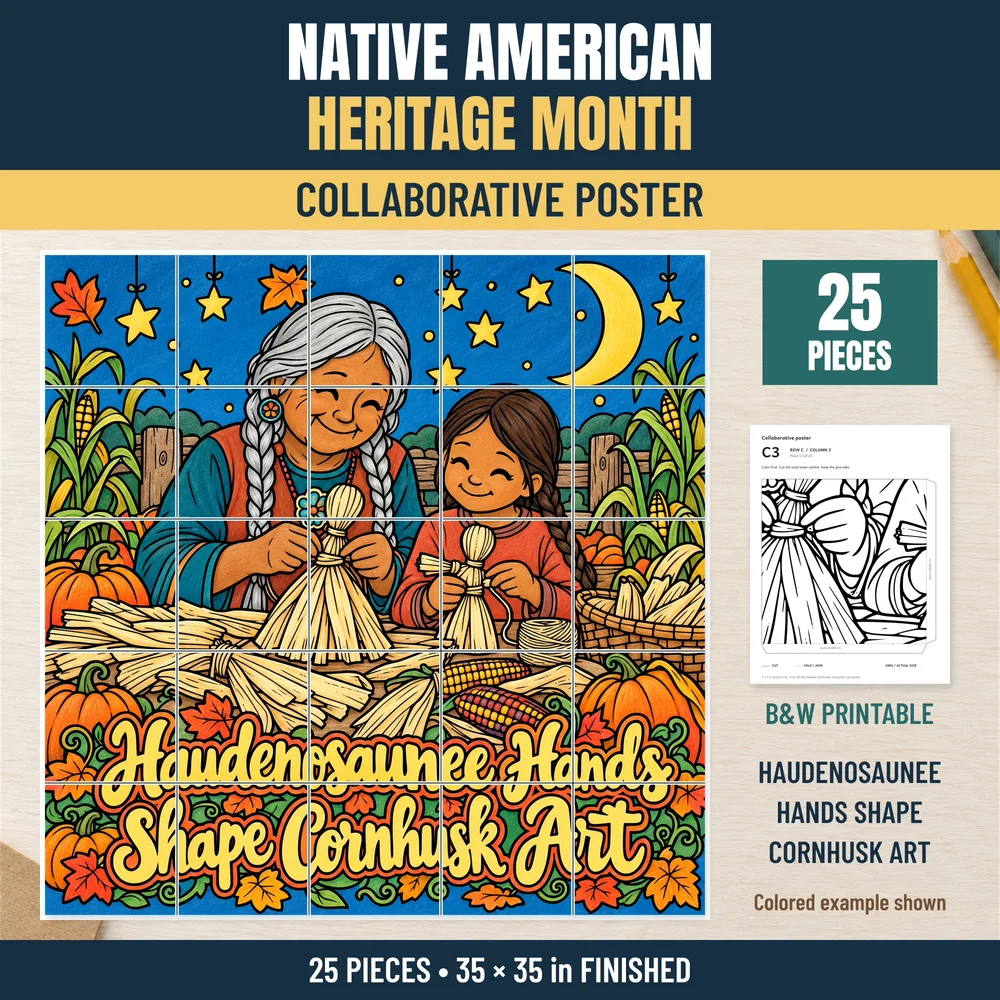
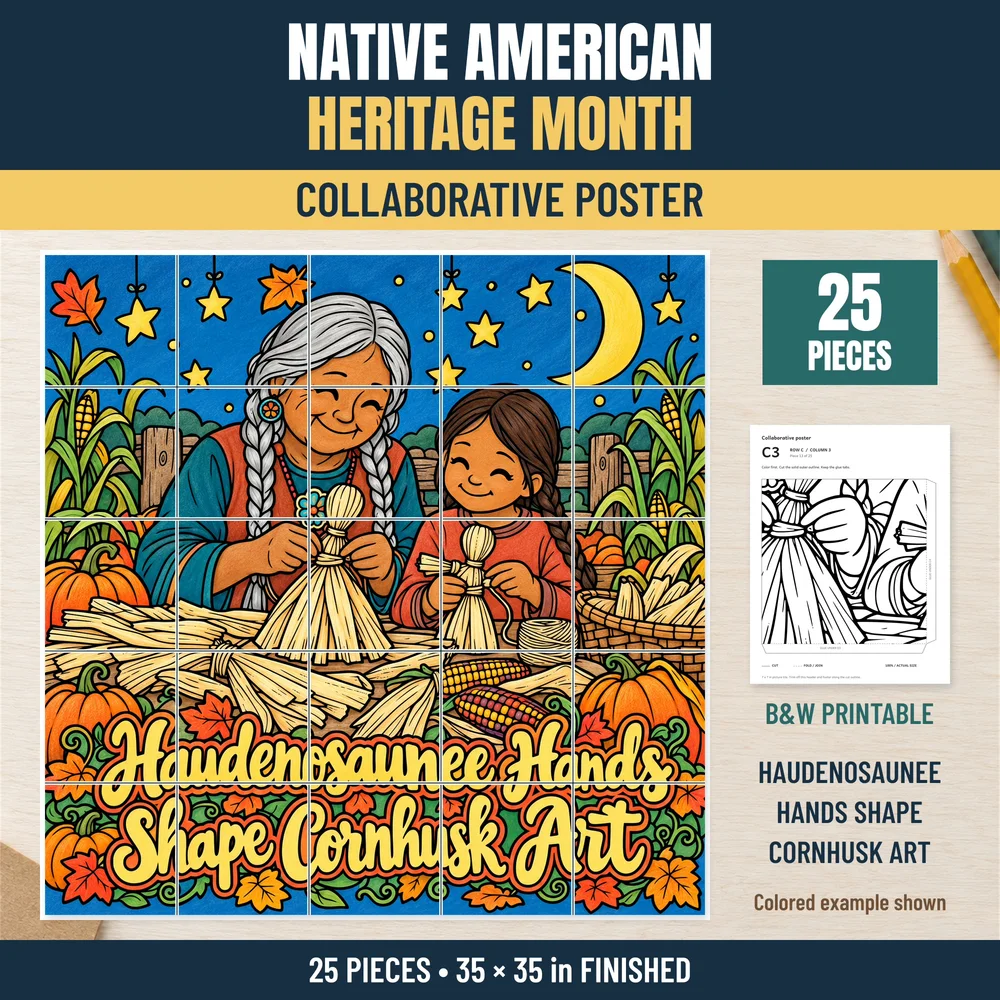
The Haudenosaunee Cornhusk Art poster puts a making activity at the center of the class display. Its illustrated theme, “Haudenosaunee Hands Shape Cornhusk Art,” gives students a concrete starting point for noticing materials, hands and the work involved in creating something together. Choose this design when you want the poster to accompany learning about a specific art form rather than a general seasonal message.
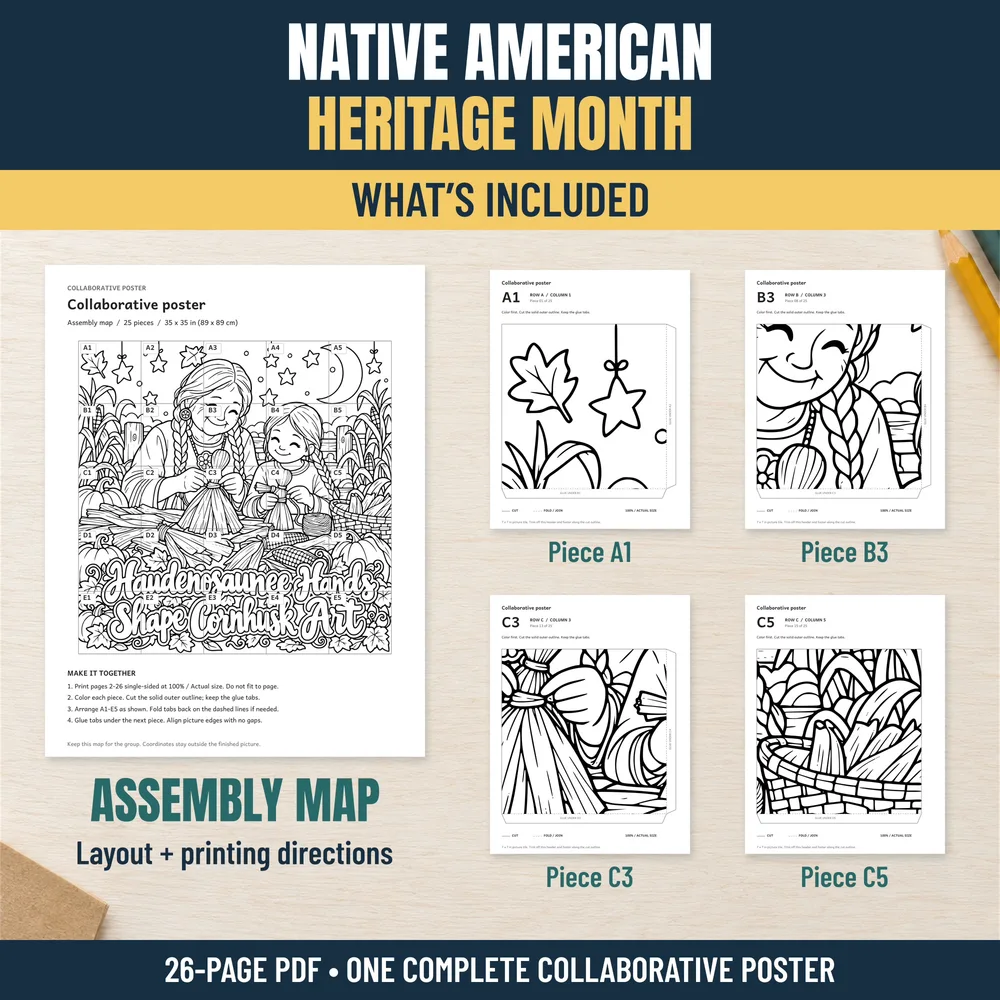
Students color their own part of the scene before joining the pieces into one square mural. The listing includes 25 picture tiles, an assembly map and glue tabs. Each picture tile measures 7 × 7 inches, and the completed display measures 35 × 35 inches.
Classroom idea: After reading a suitable Haudenosaunee-authored or museum teaching resource, ask students to separate an observation about the illustration from a fact learned in the reading. Display one of each beside the mural. Coloring this illustration can support the lesson without asking students to reproduce a traditional object.
Best for: An art-and-materials lesson, a focused November bulletin board or a social studies reading extension.
At a glance: Grades 2–6 · Printable PDF · 25 pieces · Finished poster: 35 × 35 inches (approximately 89 × 89 cm), according to the listing.
View the Haudenosaunee Cornhusk Art Collaborative Poster and download details →
2. Cherokee Seeds, Future Roots Collaborative Poster
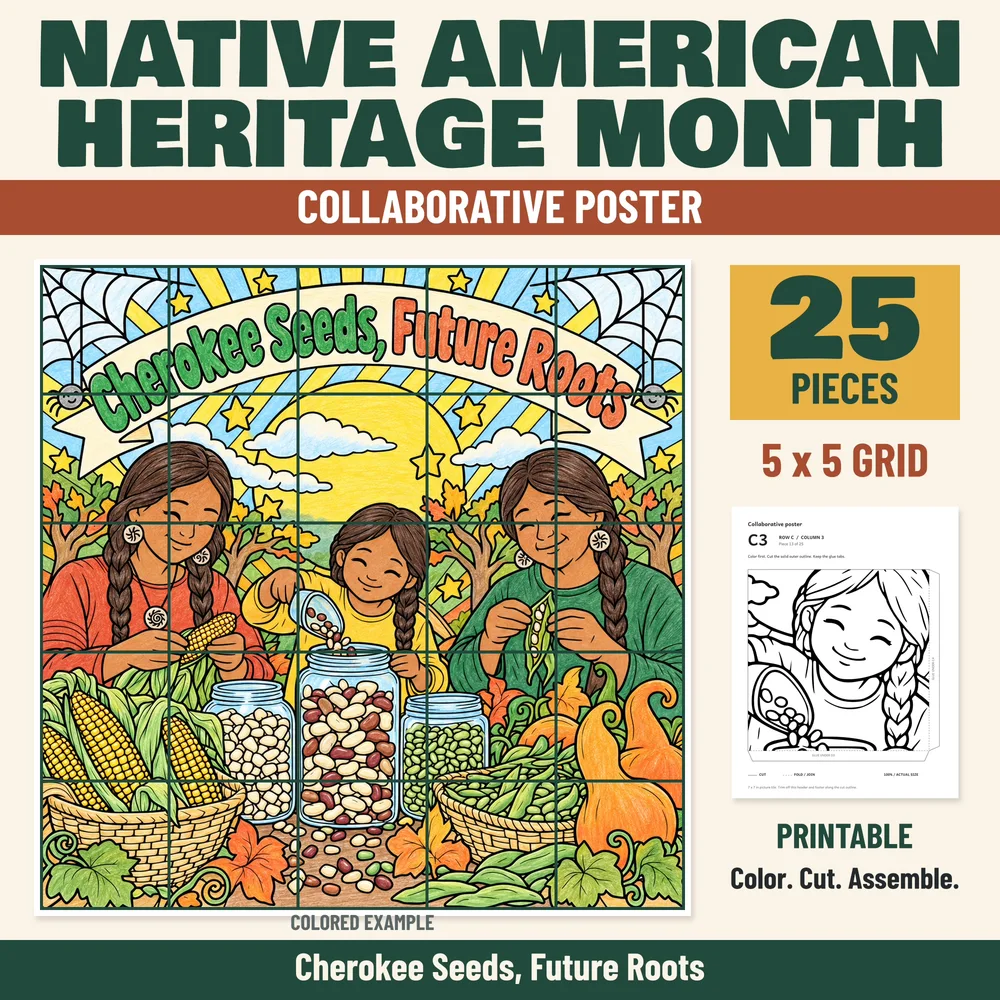
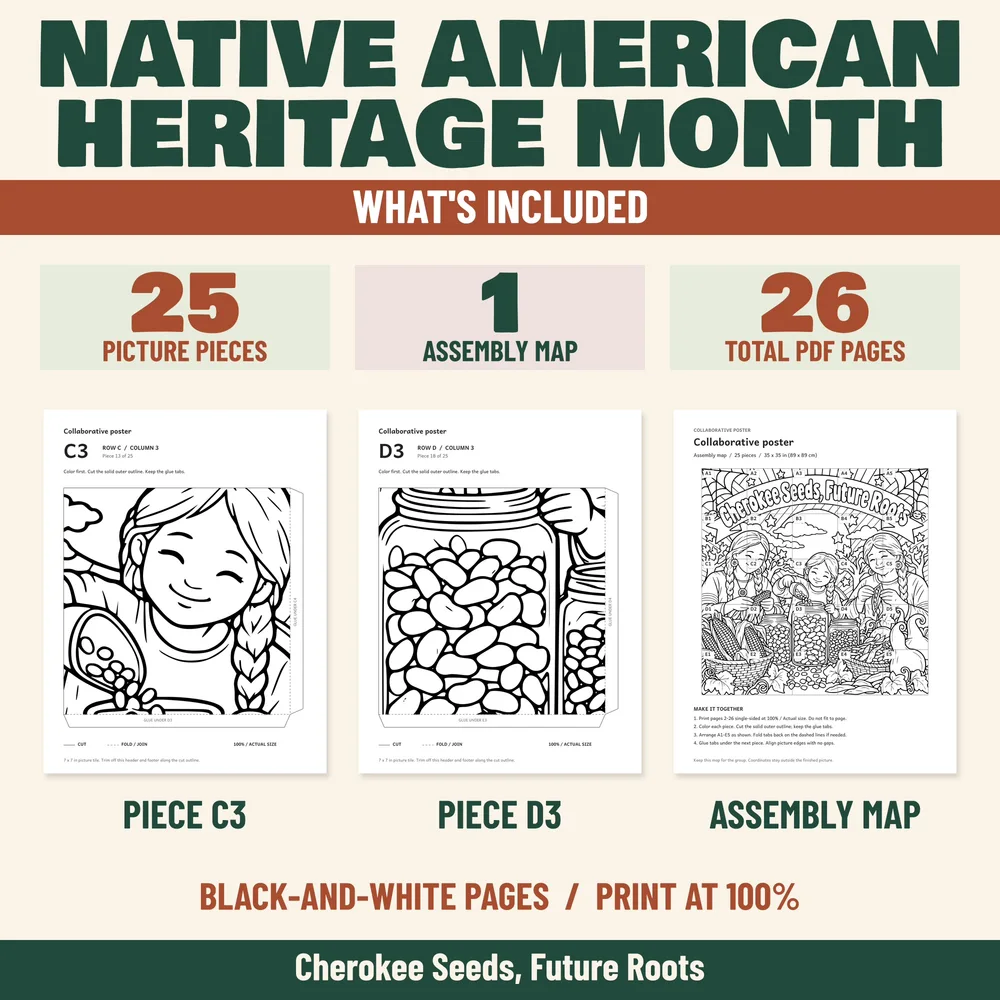
The Cherokee Art Project uses the message “Cherokee Seeds, Future Roots.” That wording makes it a useful choice for a classroom inquiry about growth, continuity and the future. Keep the Cherokee focus visible in the lesson title and pair the artwork with a source that gives students specific context.
The resource contains 25 coloring pieces, 7 × 7 inch picture tiles and an assembly map. The final poster measures 35 × 35 inches. Its shared format allows students to contribute independently, then work together to check the grid and join the finished pieces.
Classroom idea: Invite students to write one question prompted by the title before coloring. After a teacher-selected Cherokee learning resource, have them revisit the question and record a supported answer or a question still to investigate. Arrange these learning notes around the completed poster.
Best for: A growth-themed display with short research responses, a social studies center or a whole-class art session.
At a glance: Elementary and middle school · Printable PDF · 25 pieces · Finished poster: 35 × 35 inches (approximately 89 × 89 cm), according to the listing.
View the Cherokee Seeds, Future Roots Collaborative Poster and download details →
3. Diné (Navajo) Wool Becomes Woven Art Collaborative Poster
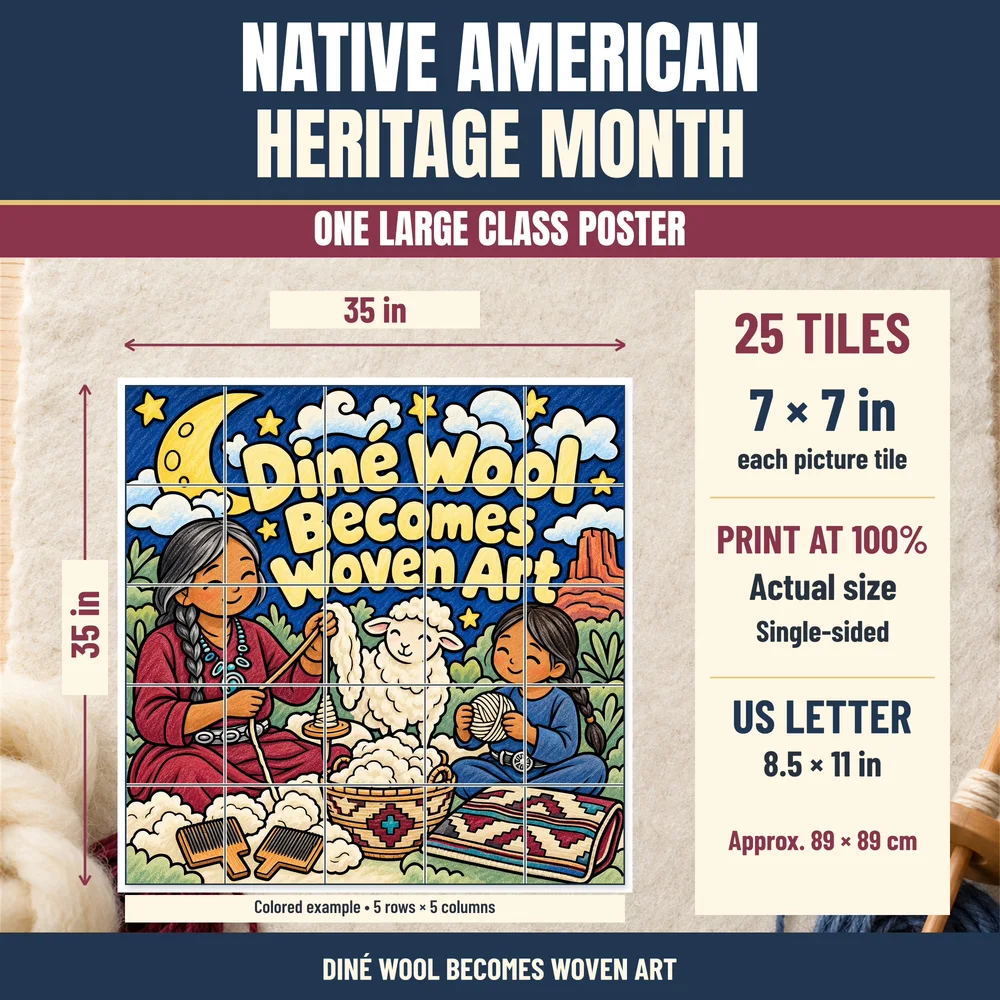
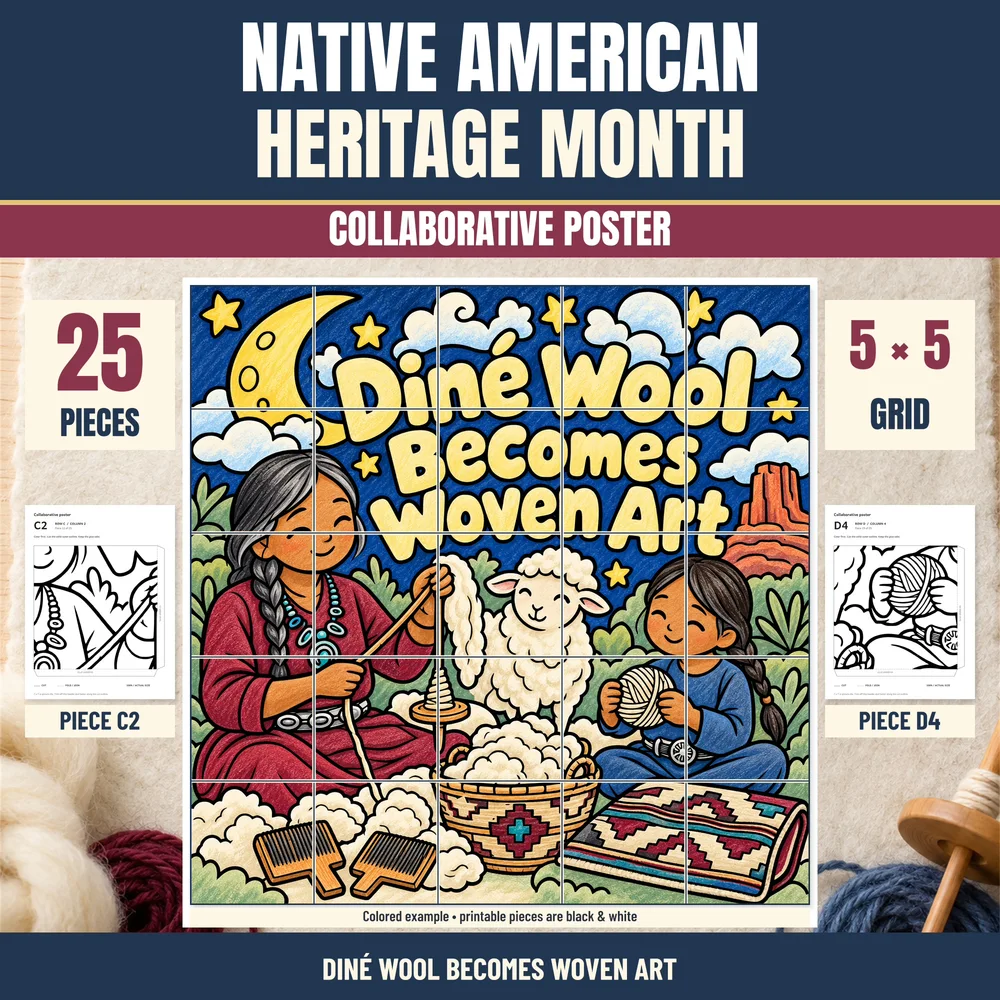
This Diné (Navajo) design centers on the theme “Diné Wool Becomes Woven Art.” The product description identifies figures, a sheep, wool-carding tools and a woven rug in the illustration. These details give the class several things to observe and discuss alongside learning about a particular Diné artist or weaving practice.
The PDF includes 25 individual coloring tiles, glue tabs and an A1–E5 assembly map. Each picture tile measures 7 × 7 inches, creating a 35 × 35 inch mural. The listing also describes variations in detail across the pieces, which can help you choose suitable assignments for different students.
Classroom idea: Use a Diné artist interview or educator-selected text to introduce materials and process. Students can make a short sequence chart based on that source, then identify related details in the poster. Keep their creative color choices separate from claims about the meaning of a design.
Best for: An art-process lesson, observation writing or a library display paired with an artist study.
At a glance: Grades 2–6 · Printable PDF · 25 pieces · Finished poster: 35 × 35 inches (approximately 89 × 89 cm), according to the listing.
View the Diné (Navajo) Wool Becomes Woven Art Collaborative Poster and download details →
4. Haudenosaunee Three Sisters Grow Together Collaborative Poster
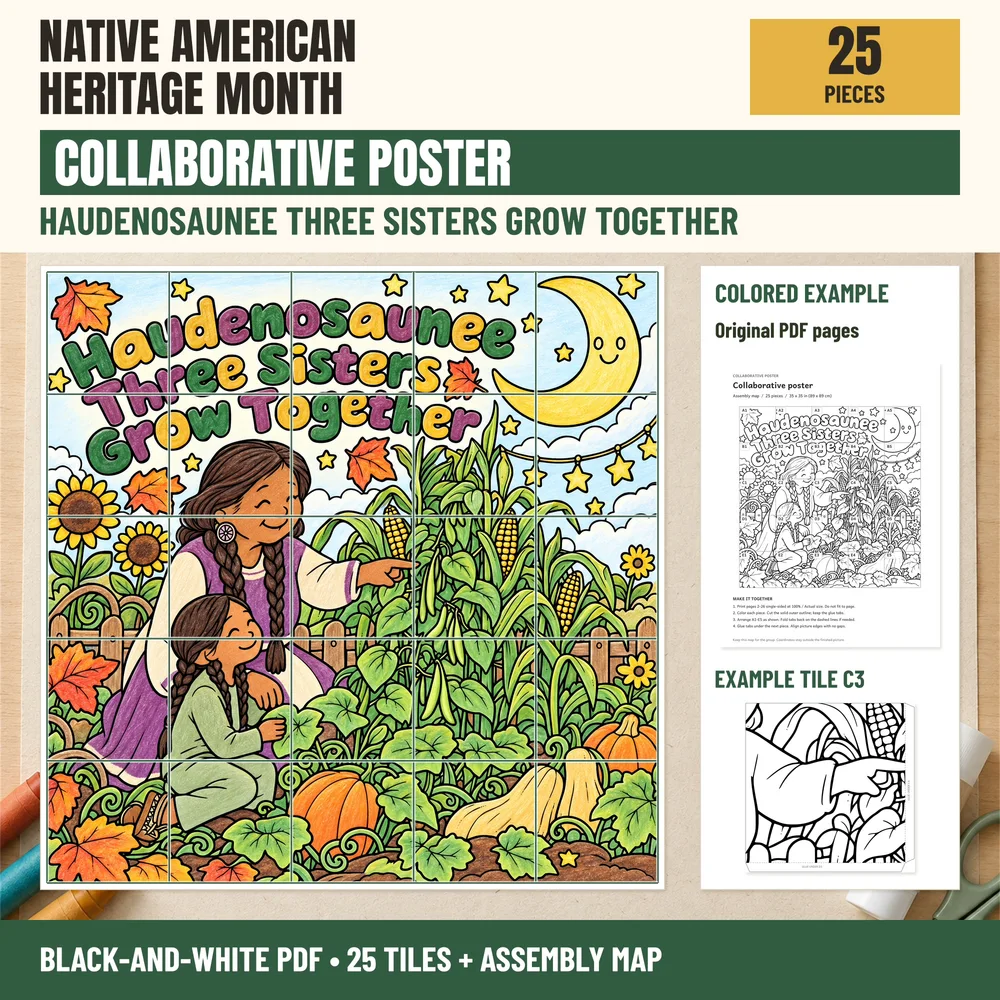
The Haudenosaunee Three Sisters poster features the message “Three Sisters Grow Together.” It offers a different focus from the cornhusk-art design: choose it when your planned learning centers on growing, food or a Three Sisters reading. The shared title also provides a natural opening for discussing how separate contributions can support one result.
The listing describes a 25-piece printable design with 7 × 7 inch picture tiles, glue tabs and coordinates from A1 to E5. An assembly map helps students arrange the pieces into a finished 35 × 35 inch display.
Classroom idea: Begin with a Haudenosaunee teaching source on the Three Sisters, then ask students to add a short, source-supported caption to the display. Use a separate reflection prompt for teamwork: What did our group need to do so every piece could connect? This distinguishes cultural learning from the class collaboration exercise.
Best for: A reading-and-science connection, a food-and-growing inquiry or a collaborative social studies display.
At a glance: Elementary and middle school · Printable PDF · 25 pieces · Finished poster: 35 × 35 inches (approximately 89 × 89 cm), according to the listing.
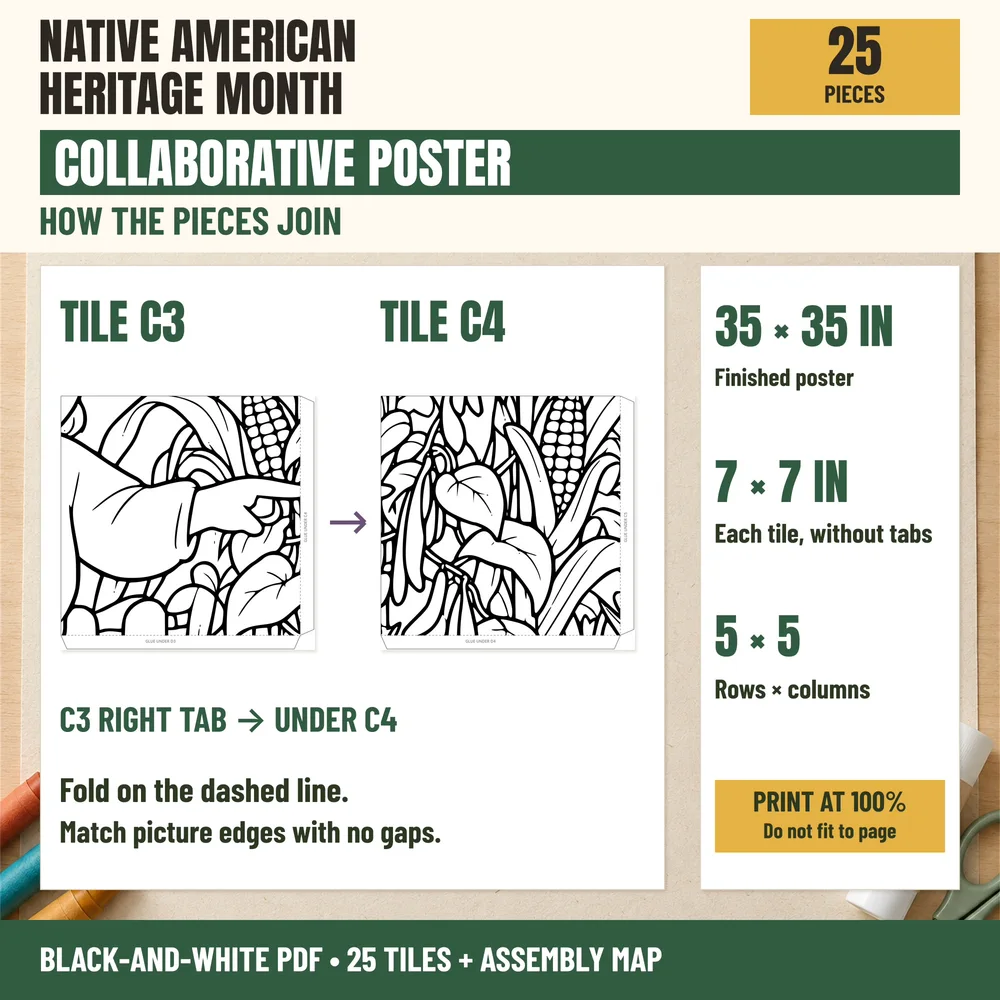
View the Haudenosaunee Three Sisters Grow Together Collaborative Poster and download details →
5. Snoqualmie Salmon, Shared Futures Collaborative Poster
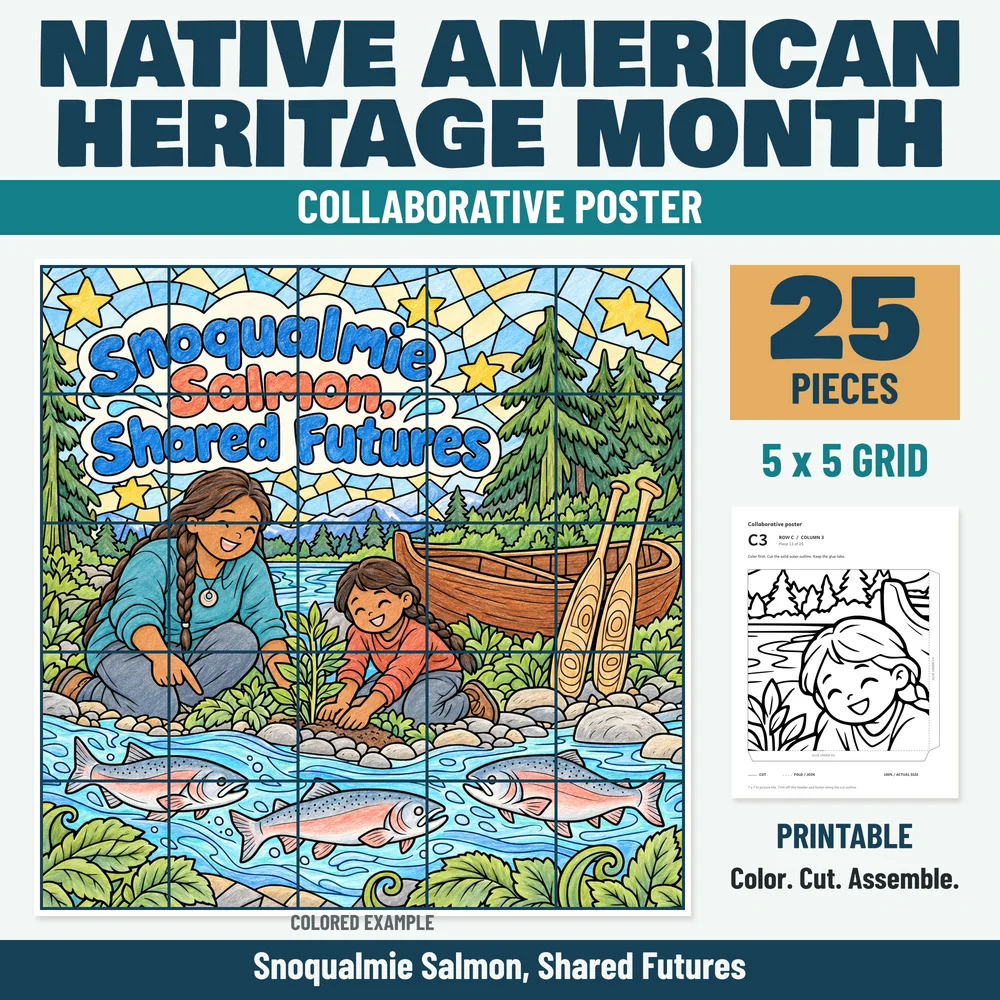
Listed in the shop as the Indigenous Peoples Day Art poster, this resource has a more specific illustrated theme: “Snoqualmie Salmon, Shared Futures.” The description identifies children, salmon and nature in the scene. It is a useful option when you want to connect a class art project with a focused inquiry about salmon and place.
The PDF contains 25 coordinate-labeled tiles and an assembly map. Students color, cut the solid outer outline and retain the glue tabs for joining. The 7 × 7 inch picture tiles assemble into a 35 × 35 inch classroom mural.
Classroom idea: Use a Snoqualmie Tribe educational resource to introduce the learning context. Invite students to record one fact from the source and one question about salmon or waterways. Add the responses to the finished display, keeping each fact attached to its source rather than inferring cultural meaning from the illustration.
Best for: A salmon or waterways inquiry, a nature-themed bulletin board or an art-and-social-studies extension.
At a glance: Grades 1–6 · Printable PDF · 25 pieces · Finished poster: 35 × 35 inches (approximately 89 × 89 cm), according to the listing.
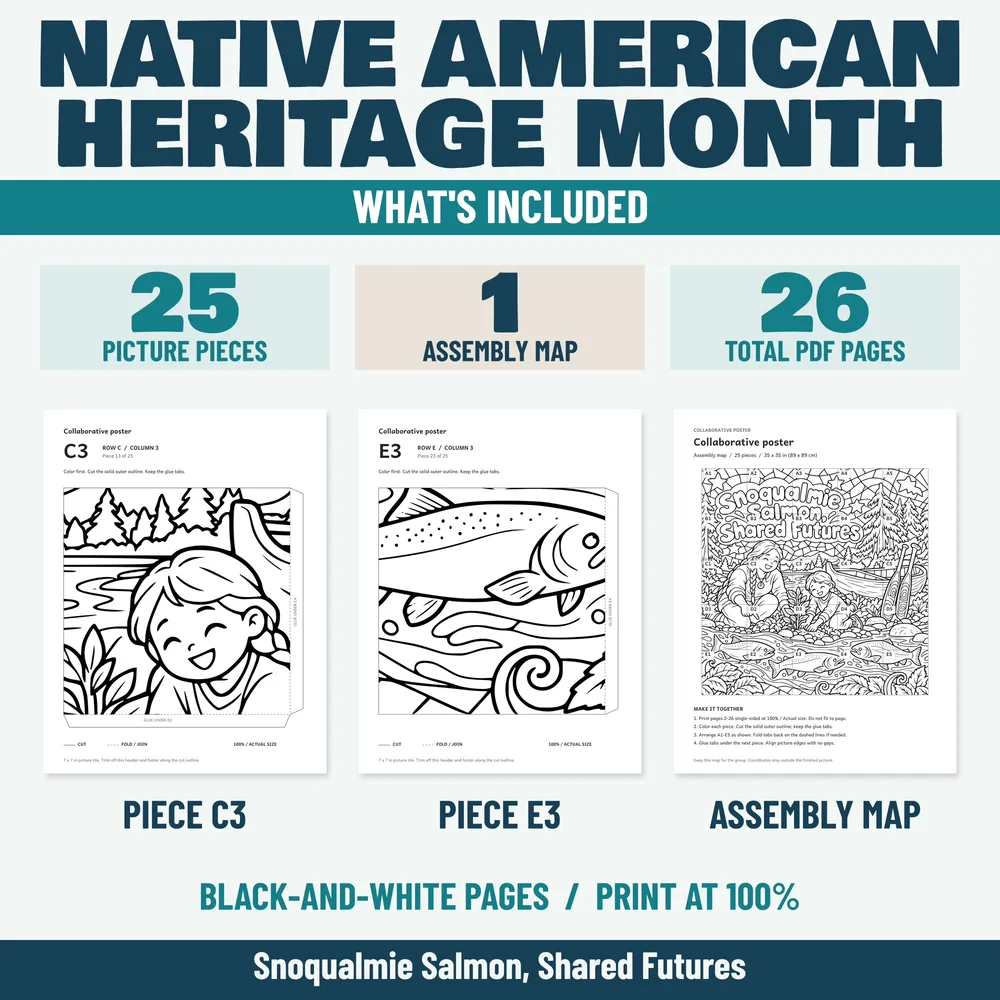
View the Snoqualmie Salmon, Shared Futures Collaborative Poster and download details →
6. Ojibwe Wild Rice Living Heritage Collaborative Poster
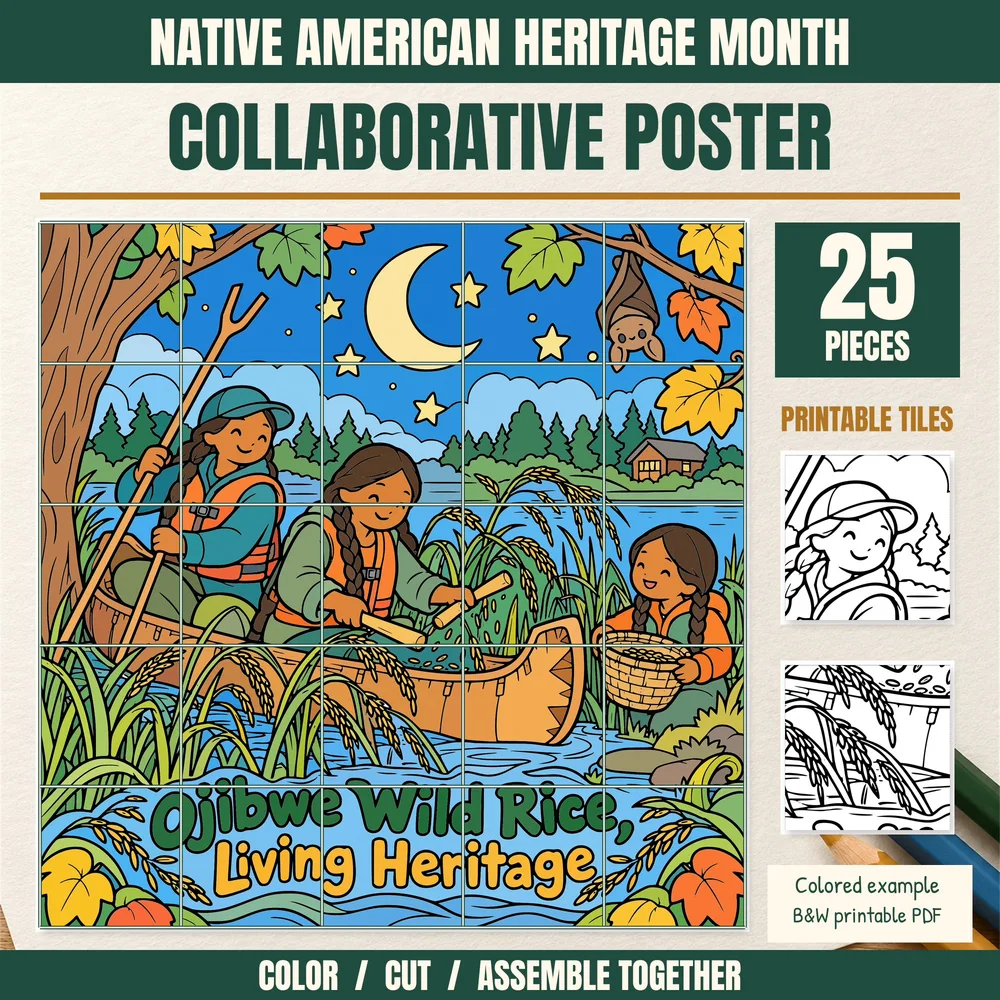
The Ojibwe Wild Rice activity uses the theme “Ojibwe Wild Rice Living Heritage.” Choose this poster when your lesson will explore a specific food-related topic through an Ojibwe source. The living-heritage wording can help frame the display around learning about people and practices in the present as well as the past.
The product includes an assembly map and 25 printable pieces with glue tabs and joining lines. Its picture tiles measure 7 × 7 inches, and the finished square poster measures 35 × 35 inches. The shop lists the activity for Grades 1–5.
Classroom idea: Read an Ojibwe-authored or tribal educational resource about wild rice. Let students draw or write one detail supported by the reading and identify the author or source. Place these responses beside the mural as a small classroom reading gallery.
Best for: A food-and-place reading lesson, an elementary social studies center or a library bulletin board.
At a glance: Grades 1–5 · Printable PDF · 25 pieces · Finished poster: 35 × 35 inches (approximately 89 × 89 cm), according to the listing.
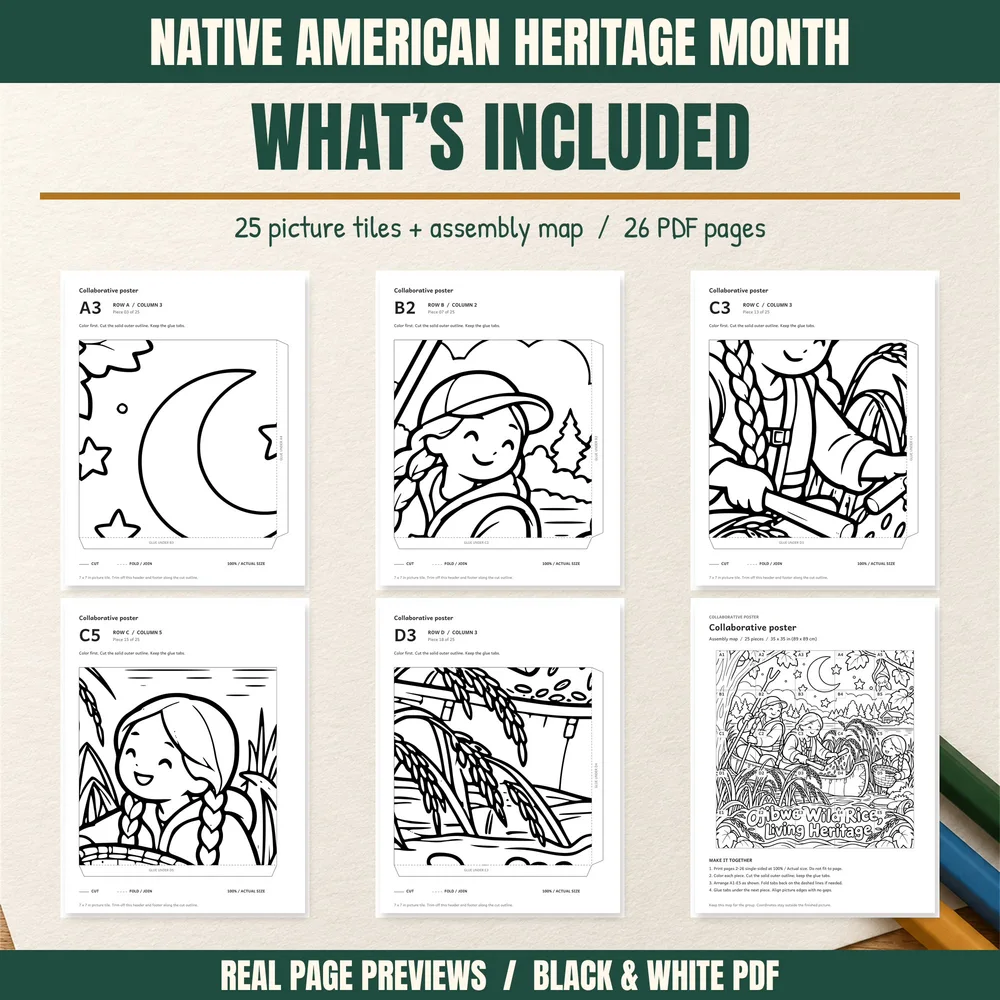
View the Ojibwe Wild Rice Living Heritage Collaborative Poster and download details →
7. Pueblo Clay, Generations of Skill Collaborative Poster
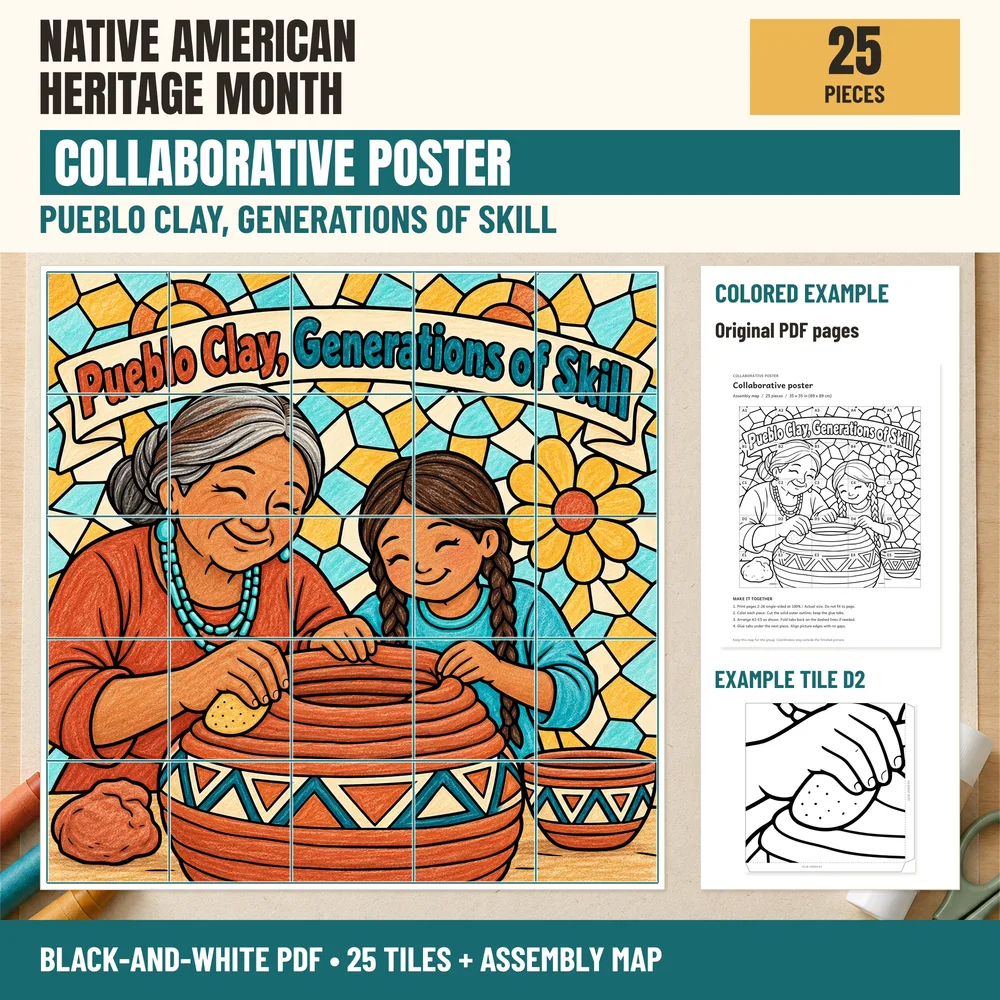
The Pueblo Art Project features the title “Pueblo Clay, Generations of Skill.” Its pottery-related theme makes it a good companion for learning about the work of a particular Pueblo artist. Build your lesson around that artist and community, giving students a specific person and source to remember alongside the class display.
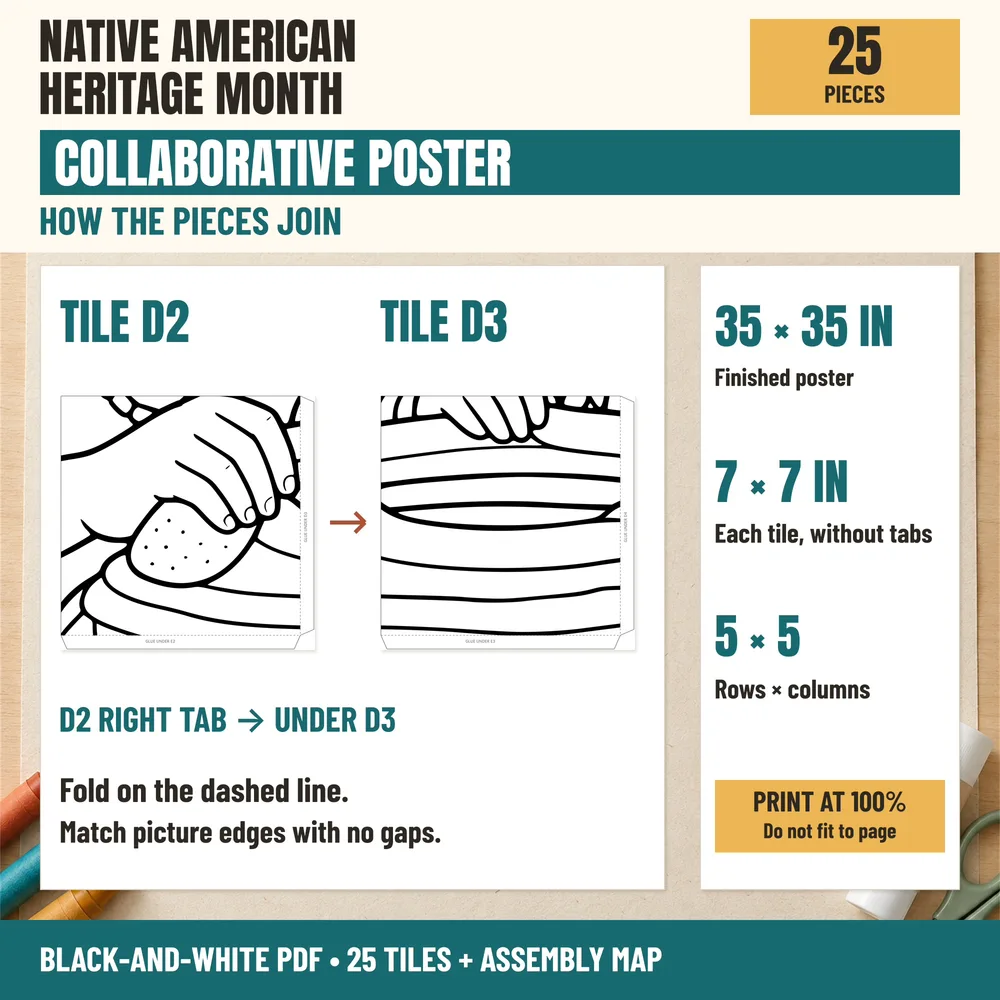
The resource includes 25 coloring pieces with 7 × 7 inch picture areas, cut lines, glue tabs and an assembly guide. Coordinates A1–E5 help organize the layout. The completed poster measures 35 × 35 inches.
Classroom idea: Show an educator-selected artist interview or read a short artist profile. Ask students to distinguish the material, a process described by the artist and something they notice in the illustration. Display the artist/source information beside the poster. The coloring task itself does not require clay or pottery equipment.
Best for: An artist-study bulletin board, an art-materials discussion or a classroom gallery about learning a skill.
At a glance: Grades 2–6 · Printable PDF · 25 pieces · Finished poster: 35 × 35 inches (approximately 89 × 89 cm), according to the listing.
View the Pueblo Clay, Generations of Skill Collaborative Poster and download details →
8. Seminole Patchwork Living Heritage Collaborative Poster
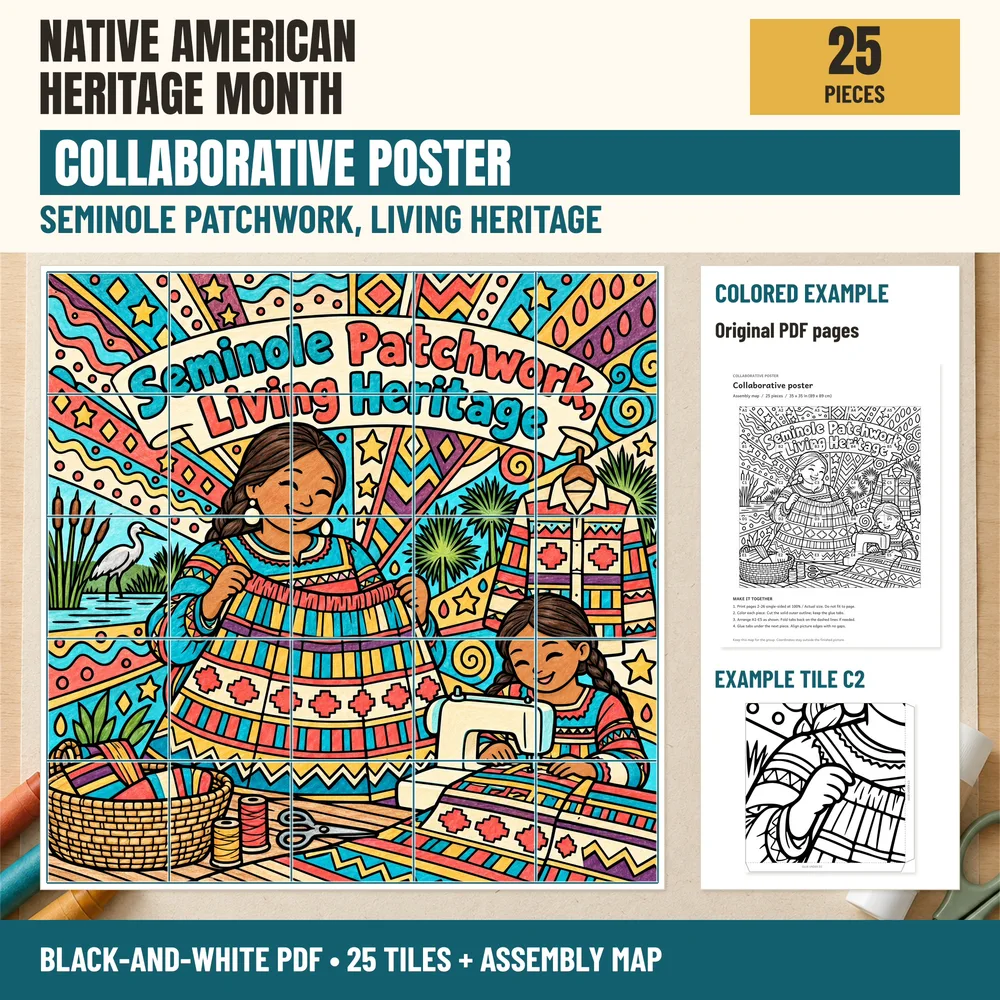
The Seminole Patchwork Art poster centers on the message “Seminole Patchwork Living Heritage.” It is a useful choice for a lesson that gives students a specific textile-art topic to investigate. The coloring activity can also support careful observation of repeated shapes, borders and color choices.
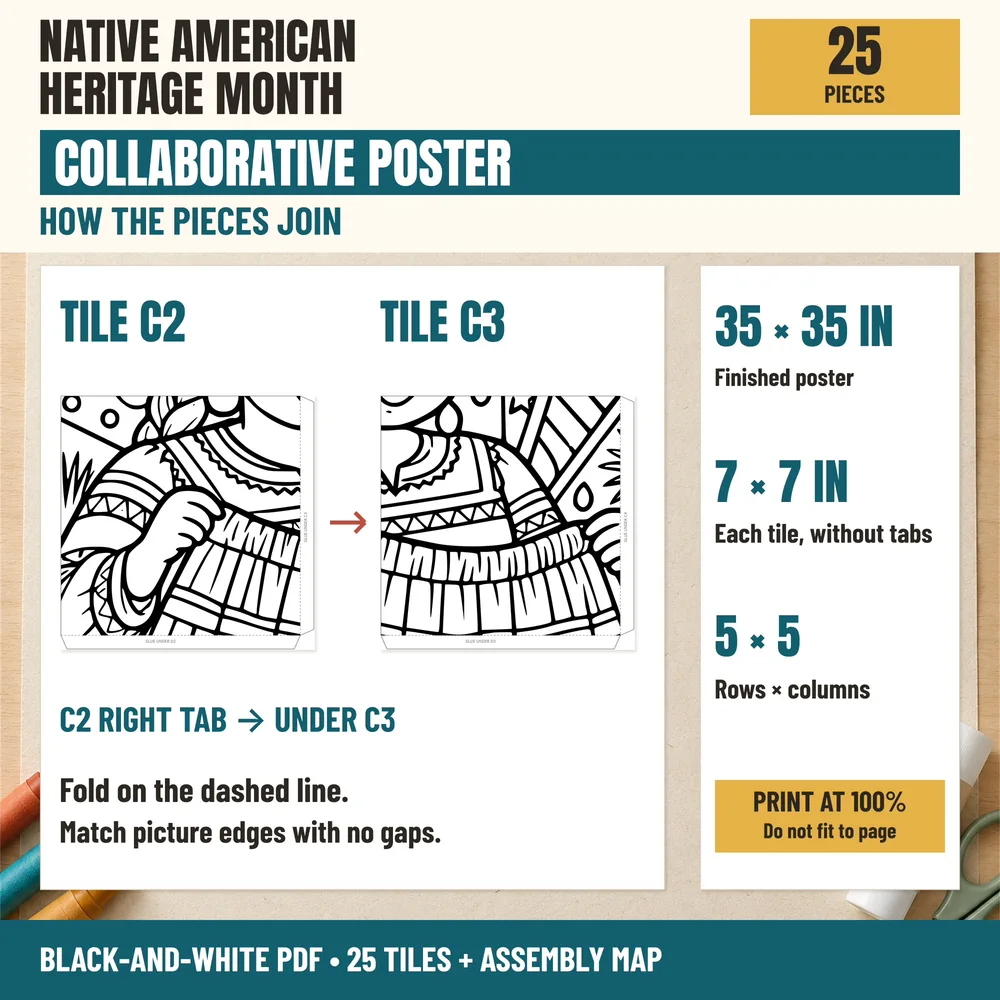
The printable contains a 25-piece design, an assembly map and directions for printing, cutting and gluing. Each picture tile measures 7 × 7 inches, and the final mural measures 35 × 35 inches. The listing identifies an A1–E5 grid for assembly.
Classroom idea: Pair the mural with a Seminole museum or artist resource. Students can describe visual features they observe, then write a separate sentence about what they learned from the source. For a math extension, create original paper pattern strips without assigning invented cultural meanings to their shapes.
Best for: A textile-art inquiry, a pattern observation lesson or a shared November art display.
At a glance: Grades 2–6 · Printable PDF · 25 pieces · Finished poster: 35 × 35 inches (approximately 89 × 89 cm), according to the listing.
View the Seminole Patchwork Living Heritage Collaborative Poster and download details →
9. Seneca Longhouses Hold History Collaborative Poster
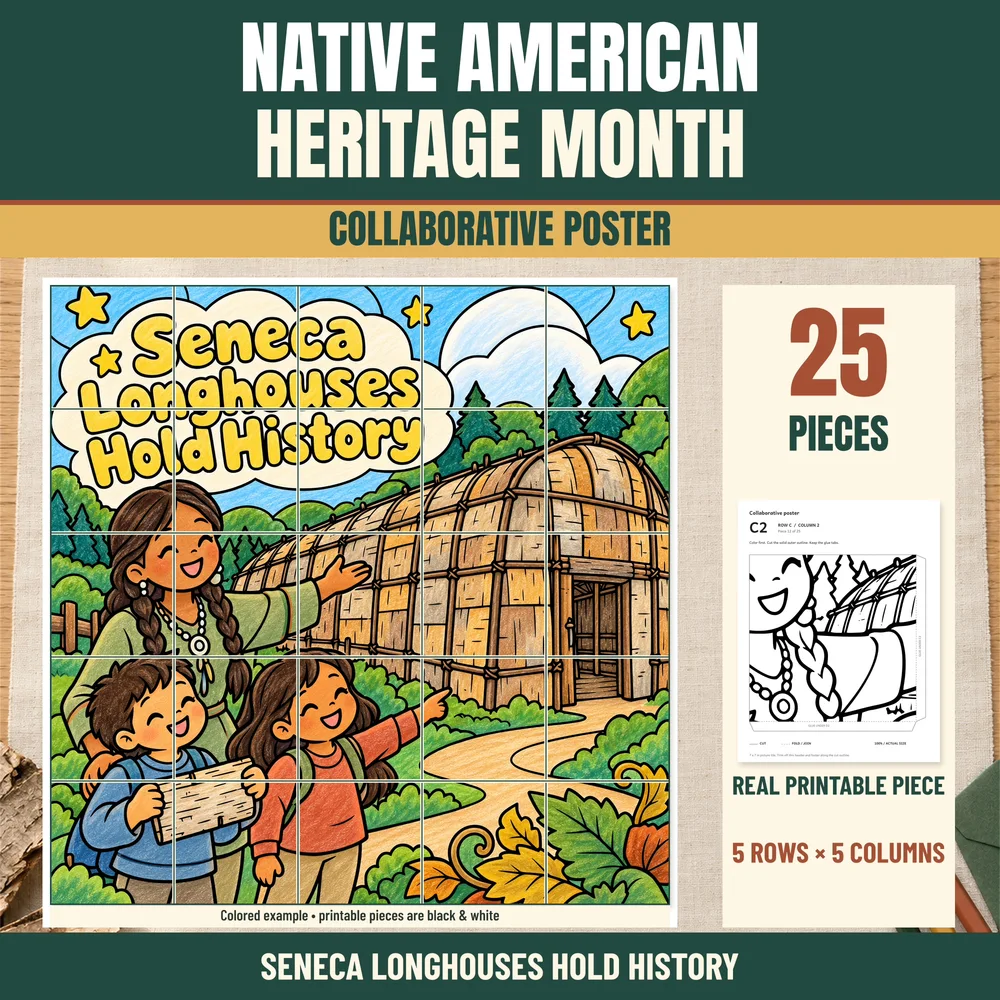
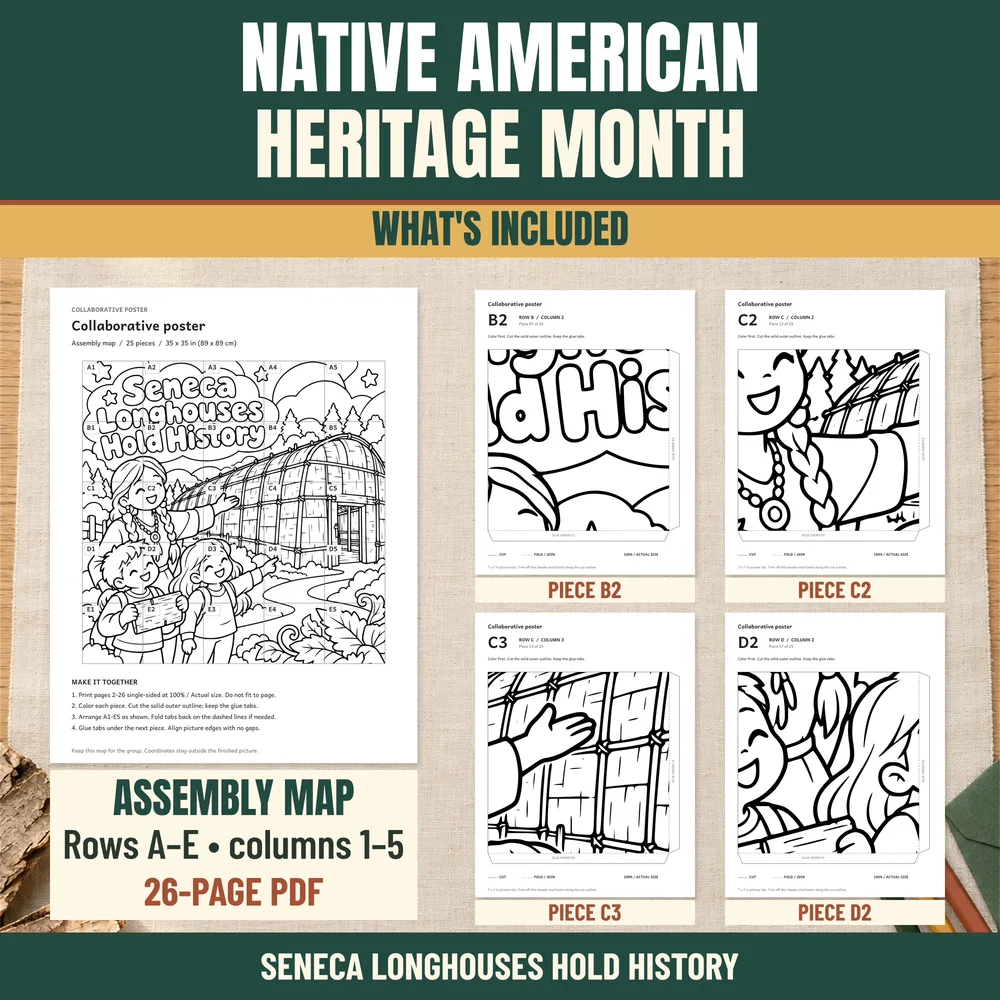
The Seneca Longhouse design uses the message “Seneca Longhouses Hold History.” Choose this poster for a focused history or built-environment reading lesson. Keep the Seneca name in the display caption so students connect the project to the particular topic they studied.
The product includes 25 individual coloring pages, 7 × 7 inch picture tiles and a complete assembly map. The pieces form a 35 × 35 inch mural. The listing identifies this as a printable, non-editable PDF, which is useful to know if you are comparing it with an editable classroom resource.
Classroom idea: After a Seneca educational reading, ask students to explain one detail about the historical subject using evidence from the source. They can add an observation from the artwork in a second sentence. Include contemporary Seneca learning materials in the broader unit so the historical scene has a clear place in the lesson.
Best for: A history-focused bulletin board, an informational-reading activity or a social studies display.
At a glance: Elementary and middle school · Printable PDF · 25 pieces · Finished poster: 35 × 35 inches (approximately 89 × 89 cm), according to the listing.
View the Seneca Longhouses Hold History Collaborative Poster and download details →
10. Snoqualmie Canoe Collaborative Poster
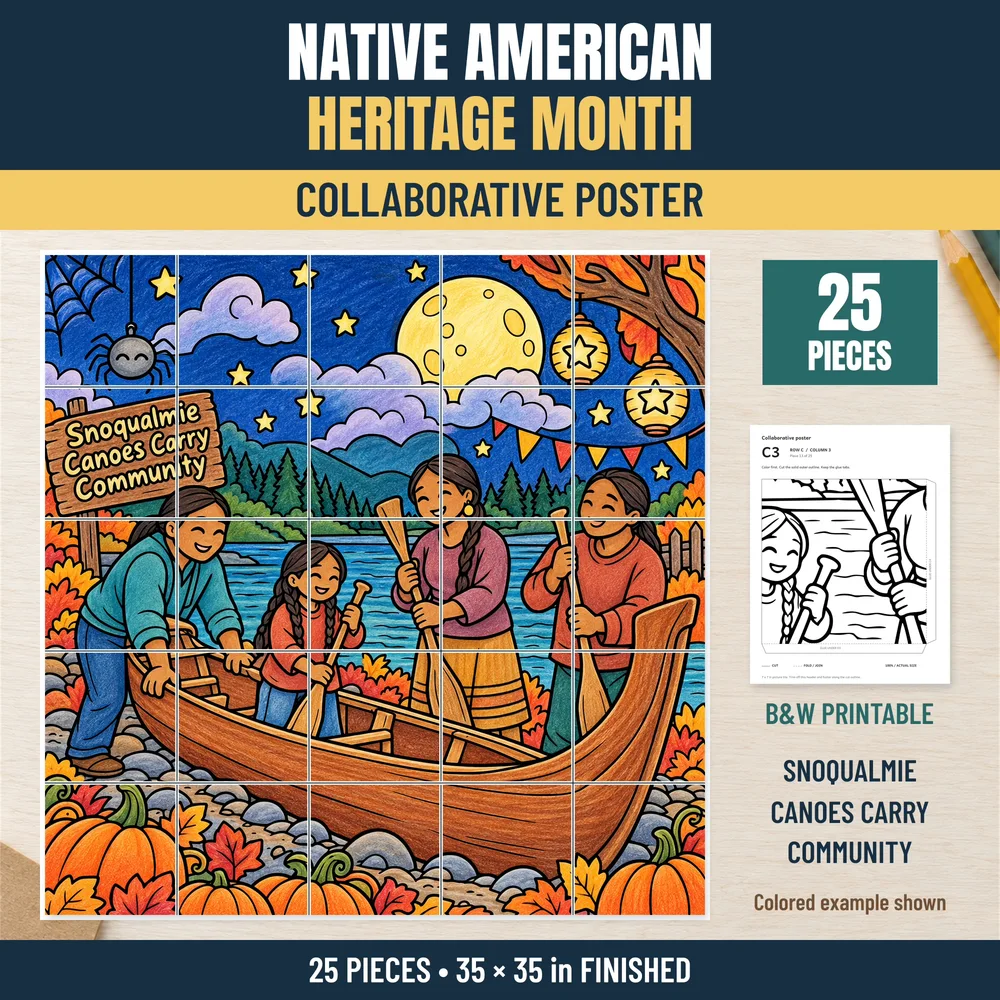
The Snoqualmie Canoe activity provides a different focus from the salmon design in the same collection. Its illustration features people in a canoe with a community-themed message and fall details, according to the shop description. Choose this resource when your planned reading or inquiry centers on canoes, waterways or community.
The PDF includes a complete 25-piece poster, 7 × 7 inch picture tiles, built-in glue tabs and an A1–E5 assembly map. The final display measures 35 × 35 inches. The listing recommends it for Grades 1–6.
Classroom idea: Use a Snoqualmie Tribe resource to provide the lesson context. After reading, have students share one supported fact about the topic and identify a question for further study. For the collaboration reflection, ask which actions helped the class align its own poster pieces and finish the shared task.
Best for: A canoe or waterways lesson, a community-themed class project or a hallway reading-and-art display.
At a glance: Grades 1–6 · Printable PDF · 25 pieces · Finished poster: 35 × 35 inches (approximately 89 × 89 cm), according to the listing.
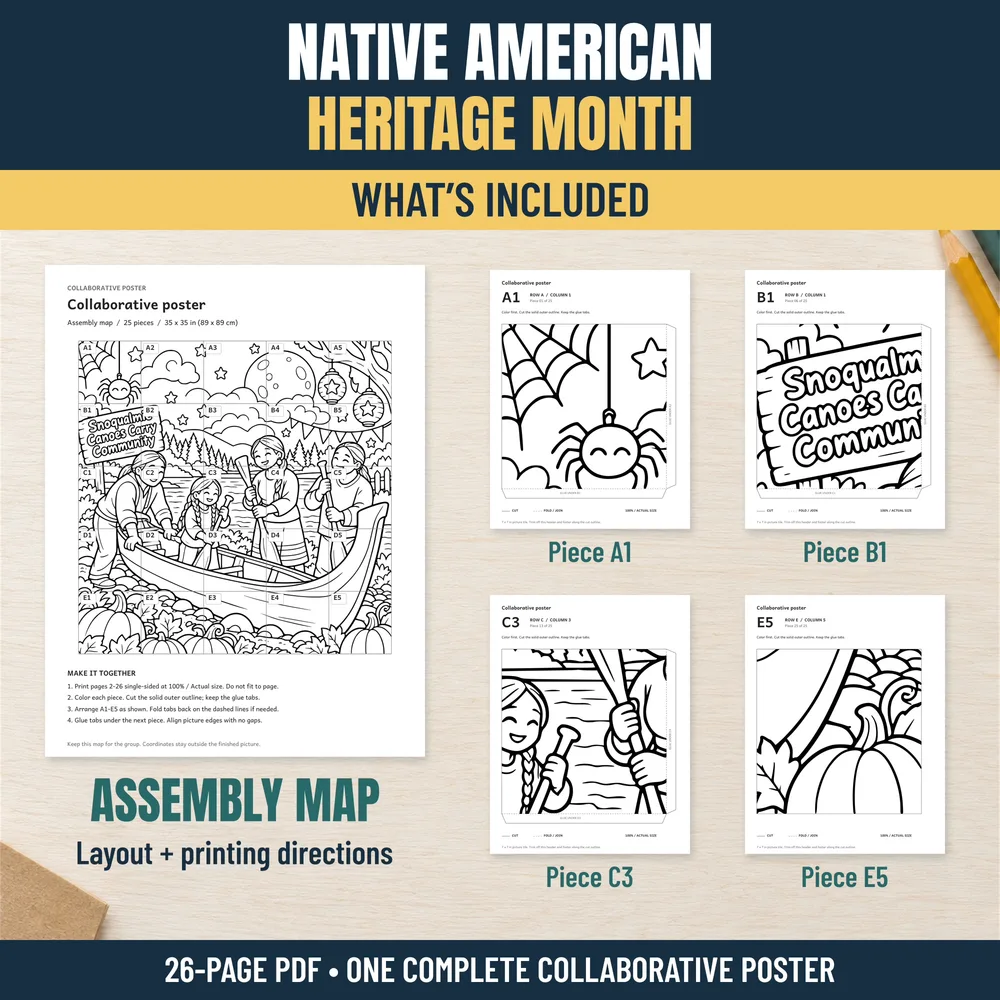
View the Snoqualmie Canoe Collaborative Poster and download details →
11. Potawatomi Ribbons Tell Stories Collaborative Poster
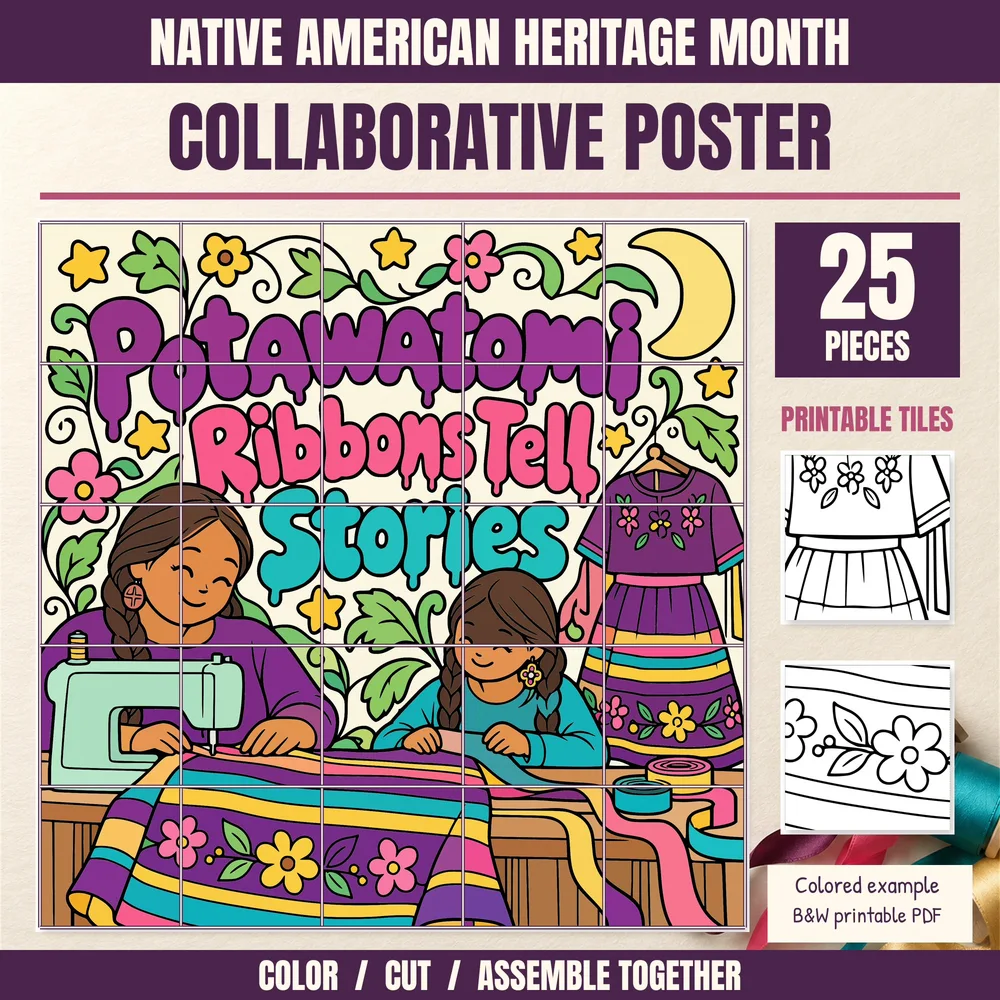
The Potawatomi Art Project uses the theme “Potawatomi Ribbons Tell Stories.” The product description identifies an illustration of women sewing ribbon skirts. This gives the class a particular making-related scene to examine alongside a Potawatomi artist, educator or community resource.
The resource contains a 25-piece collaborative poster, an A1–E5 assembly map and directions for cutting and joining the tiles. It assembles into a 35 × 35 inch mural. The shop lists Grades 2–8, making this one of the options to consider for an older or mixed-age group.
Classroom idea: Invite students to learn from a suitable Potawatomi source, then write a short caption identifying the source and one thing it taught them. They can describe the illustrated making activity separately. There is no need to have students reproduce a garment or invent meanings for ribbons to complete the coloring project.
Best for: An upper-elementary or middle-grade art discussion, a making-and-story inquiry or a focused classroom display.
At a glance: Grades 2–8 · Printable PDF · 25 pieces · Finished poster: 35 × 35 inches (approximately 89 × 89 cm), according to the listing.
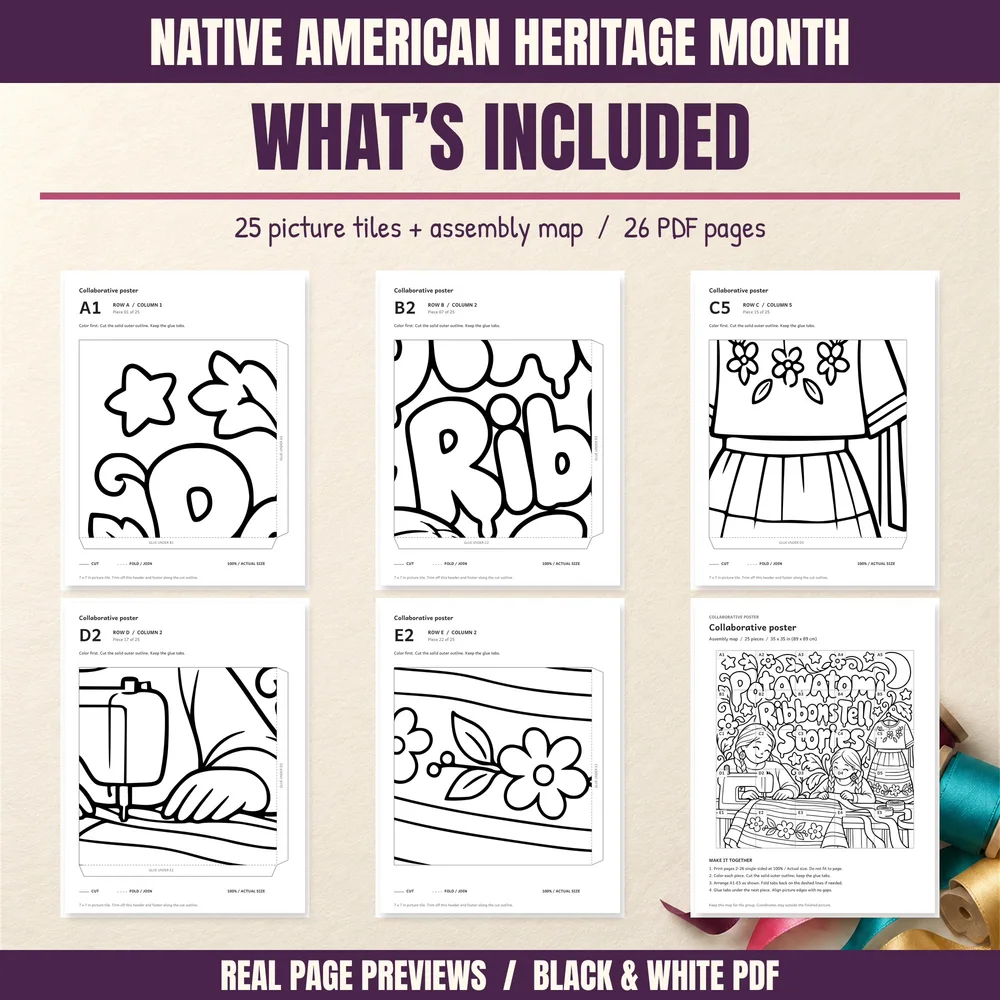
View the Potawatomi Ribbons Tell Stories Collaborative Poster and download details →
How to print and assemble your chosen poster
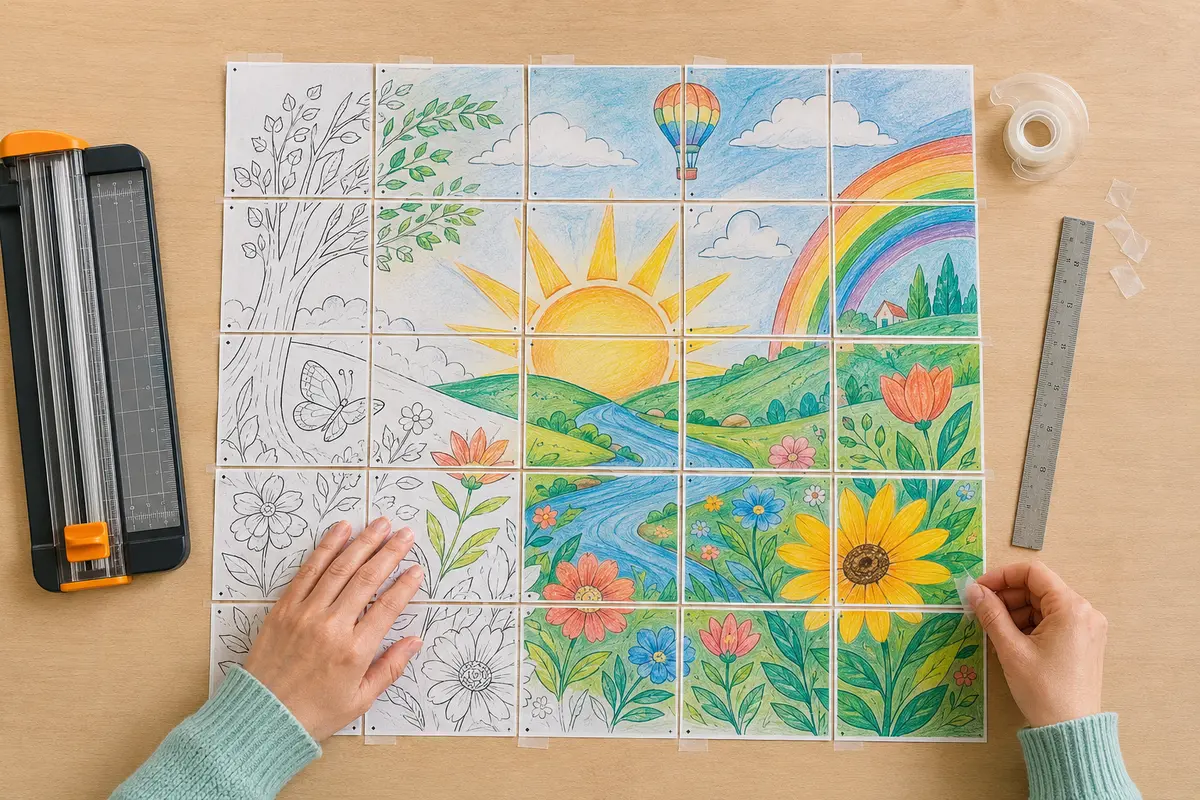
The product descriptions identify a shared 25-piece format and a finished size of approximately 35 × 35 inches. Check the instructions in the specific PDF you download before printing.
- Open the PDF and find the assembly guide. Keep the reference map separate from the student coloring pages. Several listings identify pages 2–26 as the 25 poster pieces.
- Print one test sheet. Follow the file's paper-size instructions and use single-sided printing at 100% or Actual Size. Avoid Fit to Page when the instructions specify actual size.
- Assign every piece. Give each student a tile, assign extras to volunteers or pairs, and keep a checklist so no coordinate is missed.
- Color before cutting. Where the file specifies glue tabs, retain them and follow the printed cutting and joining directions.
- Check the grid before gluing. Arrange the pieces against the assembly map, confirm their orientation and join them a row at a time.
Allow additional space around the mural for a title, source information and student writing. A 35-inch square is the poster itself; backing paper and captions will require more wall space.
Turn the artwork into a learning display
Keep the completed mural as the center of the bulletin board and add a small number of readable captions. Useful prompts include:
- I notice… for an observation about the illustration.
- Our source explains… for a fact supported by the reading, interview or teaching resource.
- I still wonder… for a question to investigate next.
Include the source title and the relevant author, artist, nation or community information. For teaching materials, the Smithsonian National Museum of the American Indian's Native Knowledge 360° is a starting point for finding lessons and educator resources. Select the materials that fit your topic and grade level.
Find the design that fits your next lesson
Choose one poster for a focused classroom project, or compare several designs while planning your unit. Each product link above takes you directly to that design's preview and download information.
Explore all Native American Heritage Month collaborative posters →
Product information and gallery images checked against the 11 individual shop listings on October 19, 2026. Classroom extensions are suggested lesson ideas. Product availability and listing details may change. Product images are displayed from optimized copies of the shop previews and link to the corresponding product.
Ready to create together?
Choose a printable, give every student a piece, and watch the big picture come to life.
Explore Native American Heritage Month posters ↗Frequently asked questions
How should I choose a Native American Heritage Month poster?
Choose a specific subject and nation or community before selecting the artwork. Compare the Diné weaving, Ojibwe wild rice or Seneca longhouse themes with the sources you plan to teach.
What is the listed picture size for these posters?
The checked descriptions identify 25 picture tiles forming a 35 × 35-inch mural at the intended scale. Read the chosen PDF for its own printing and joining directions and allow extra space for source labels and student responses.
Can the poster replace learning from a named source?
No. Pair the chosen theme with an appropriate artist, community or educational source. Keep students’ creative coloring choices separate from claims about the cultural meaning of a design.
Can I use the resource outside Native American Heritage Month?
Yes. A focused artist study, reading or social studies inquiry may fit another point in the curriculum. Keep the specific subject, community context and source information visible whenever it is used.
What can students add beside the finished artwork?
Ask for an observation, a source-supported statement and a question to investigate. Check the wording and identify the source so a visitor can distinguish the illustration from what the class learned.